Friday, October 10, 2014

Moadim L'Simcha

We focused our attention during the previous weekday sessions on one of the most joyous of Jewish holidays - Sukkot. Immediately following the more somber and contemplative High Holy Days, we are commanded to build a sukkah and to take the branches of the palm, myrtle, and willow trees, along with the fruit of the "etz hadar" (translated as the "goodly," "majestic" or  "splendid"  tree by various sources - Rashi, the 11th century scholar, insists this refers to the "etrog" or citron tree), and be joyous. What the commandment fails to tell us is how to be joyous using these symbols of the holiday.

Our Edot students had a lively discussion relating to how we could express joy using the lulav (the palm, myrtle and willow branches) and etrog. One student thought that we could use them to perform a hula dance, another that we could attach lights to them and create happy designs in the darkness of the night, under the full moon. The ideas kept coming. We finally took a look at a Torah Aura Instant Lesson entitled, "Palm, Willow, Myrtle" to learn how Talmudic era Rabbis interpreted the commandment. We discovered there were multiple Rabbinic interpretations, just as our own students had different ideas. For example, one Rabbi taught that the palm branch represented the human spine, the myrtle leaves were like the human eye, the willow leaves resembled the human mouth, and the etrog was like the human heart. We hold them together so that the entire body will praise God. Another Rabbi taught that each of the 4 species (as the 4 parts of the lulav are referred to) reminded us of the different parts of the Land of Israel - as we rejoice, we should never forget our connection to the Land of Israel. We concluded our discussion by learning the laws and blessings relating to the ritual of shaking the lulav and etrog. We also learned that it is during this holiday that we ask God to send us rain. The shaking of the lulav, some students noted, might sound like rain falling.

Immediately following t'fila, we went outside to the amphitheater area to visit the sukkah built by the 3rd and 4th graders in the Bonim track last week (very impressive!). We all managed to fit into the sukkah, and there we discussed the symbolism of the sukkah and its importance in helping us recall our nomadic roots before we settled in Canaan, as well as our farming roots in the Land of Canaan.

Hopefully our ancient ancestors had more room to move around in their sukkot than we did!
I also introduced Sukkot vocabulary to the students during our Hebrew Through Movement session.

Samantha, la'tet etrog l'Ian (Samantha, give etrog to Ian)
Ian, l'hareem etrog me'al ha'rosh  (Ian, raise the etrog over the head)
Ari, la'tet lulav l'Jason (Ari, give Jason lulav)
Jason, lee'tol lulav (Jason, shake lulav)
Finally, I thought I'd share with you a couple of photos I took during our hafsaka (recess). Fifth and sixth graders from all 3 tracks go upstairs to the lawn outside the Sanctuary for about 15 minutes each weekday session, where the children can run around to their hearts' content, usually playing ball games or standing around and shmoozing.

Climbing the stairs to the lawn
Enjoying a ball game under a clear, blue sky
Hopefully, you had a chance to see the beautiful, full moon which rose above the hills Wednesday evening, to welcome the Sukkot holiday. Be joyous during this "season of joy" - MOADIM L'SIMCHA!

Thursday, October 2, 2014

G'mar Chatima Tova

During the past week, we continued to explore traditional Jewish beliefs about time and its purpose. This is a particularly important subject for our Edot studies, because it was this strong and unwavering belief in the purpose of time which allowed the members of each edah to maintain their Jewish identity and connection to other Jews around the world, even in the face of adversity.

On Sunday, we discussed the Jewish understanding of history, as propounded by the Biblical prophets and later by Talmudic era Rabbis. According to the Rabbis, time began with Creation and will end when the world is in "balance" - when justice has been achieved for all living things - and the Messianic Age will set in. In the Talmud, many Rabbis refer to this Age as 'Absolute Time', when the dimension of time as we know it will end, and we will begin a new existence in the dimension in which God exists - no past, no present, no future.

As we "balance on the timeline" (the metaphor I've introduced to Edot students), we move forward toward Absolute Time by following God's commandments, and doing whatever we can to help "repair the world" (tikkun olam) and bring justice to all living things. According to the teachings of the prophets, God will bless us when we follow the commandments, but will send our enemies upon us if we break them. Every historical event to them was a reflection of how well we "kept our balance." We learned that about 2,000 years ago, during the Roman occupation of Judea, a group of Jews who believed that the Messiah had finally arrived in the person of Jesus of Nazareth, believed that time had ended and stopped counting the years. When they realized that injustice still reigned, they developed the concept of the "Second Coming," believing that God had sent Jesus to earth to remind us to continue our efforts to bring justice and balance to the world, and that when Jesus came again, time would end. So they began counting the years from Jesus' birth. This led us to a discussion of the terms B.C. and A.D. (Before Christ and Anno Domini) and our Jewish use of the terms B.C.E. and C.E. (Before the Common Era and Common Era). As a closing activity, each student was given a piece of paper on which to create a timeline, beginning with Creation and ending with the Messianic Age. As we learn about specific edot and Jewish historical events over the course of the school year, we'll note these on the timelines.


During the weekday sessions, we continued the theme of "balancing on the timeline" by looking at what happens when we "fall off" and need to "return" in order to continue our individual and community efforts to effect tikkun olam. The Hebrew word for returning is "t'shuva" which we commonly translate as "atonement." Using a case study approach, students were divided into four small groups, each group being assigned one case study of a person who had made a mistake, hurting themselves and others. Each group was asked to consider if the person had "achieved full t'shuva" or not, and to prepare to defend their decision. From this activity, we determined during the ensuing class discussion that there are four steps which must be followed in order to achieve complete or full t'shuva. They are:
  1. Realize you have made a mistake and what it is;
  2. Apologize to yourself and to all others hurt by your mistake;
  3. If possible, correct the immediate situation caused by the mistake; and
  4. Make a plan for how to avoid making the same mistake again
To bring this lesson to our own classroom, I have shared with the students that if they "fall off the timeline" by acting inappropriately during class (i.e. talking at inappropriate times, hurting property, or in any way making anyone feel unsafe or unwelcome in our classroom community), I will give them two verbal warnings, after which, if the behavior still persists, I will ask them to write a "t'shuva essay." This involves writing one or two sentences for each of the above 4 steps of the t'shuva process. It will give the student a chance at home to reflect on what they did and how it affected others in the class, as well as giving them the opportunity to plan for how to avoid the behavior in the future.  I have a poster hanging in Room 201 to remind everyone of the four steps:


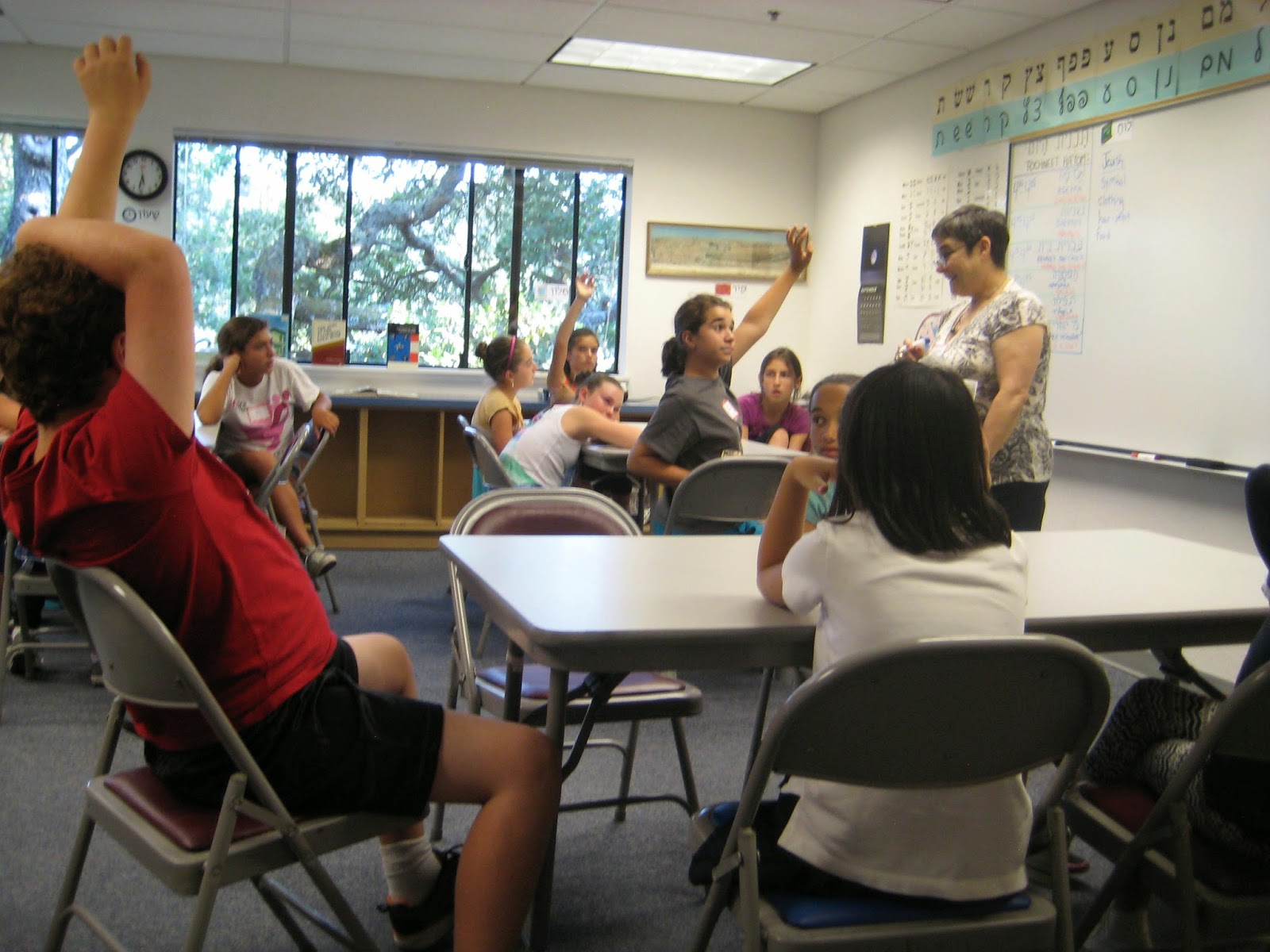
Here is a glimpse into our classroom during the past weekday sessions, as the students in one group were discussing their assigned t'shuva case study:


As a closing activity to this session, I gave each student a "T'Shuva Worksheet" which allowed them, using sentence starters, to make some reasonable goals for themselves for the coming school year.
Once they completed writing their goals on the worksheet, they were asked to fold the sheet in thirds, then put the worksheet into an envelope. After writing their full name on the envelope, the students were each given a sticker to "seal" their goals in the envelope. These will be returned to the students the final week of Religious School in May, at which time they can "break the seal" and see if they were able to achieve some, if not all of the goals they set for themselves.

During our Sunday Hebrew Through Movement sessions, I had a wonderful surprise. After our usual warm-up of review vocabulary, several students asked if they could give the commands. We only had enough time for two of the students, both of whom did a fantastic job!


This coming Tuesday evening we are holding our annual "Back-to-School" night for parents. I'm looking forward to seeing many of you, and to sharing the exciting year we have ahead of us and to answering any questions you may have about our Edot curriculum. In the meantime, I'd like to wish you and your families  G'MAR CHATIMA TOVA.  May you have been sealed in the Book of Life!

Tuesday, September 23, 2014

L'Shana Tova Tikateivu - May You Be Written for a Good Year

We say goodbye tomorrow just before sundown to the Jewish year 5774, and at sundown we welcome the new year - 5775. One year ends; another begins. Seems simple enough. But our Edot students discovered this past Sunday that Jewish observance of Rosh Ha'Shana is not simply saying goodbye to the past year and welcoming the new year, as we do December 31st into January 1st on the Gregorian calendar. This holiday reflects the Jewish revolutionary beliefs about the shape and purpose of time, our belief in One God and the relationship we have developed as "partners" with God. We learned that while ancient peoples believed that the shape of time was a circle (sunrise, sunset; season following season in the same order every year; new moons waxing into full moons then waning into new moons again, etc.) repeating without fail no matter how they acted, Talmudic era Rabbis determined that there is a linear aspect to time - a timeline, if you will - which began at the moment of Creation. Since God created time, and everything that God created must have a purpose, according to the Rabbis, time must have a purpose. Events occur in linear progression on the timeline, and these events are determined by whether we - Israel - follow God's commandments or not. Follow them and God will bless us; don't follow them, and God will send our enemies to punish us.

According to Jewish belief, it is the role of Israel to be a "light unto the nations," i.e. to model how to "balance on the timeline," (following the commandments) in order to effect "tikkun olam" (repairing the world). Once every individual, every community and nation is "balanced," we are told by the Rabbis that time will end - its purpose will have been served - and we will enter into a new dimension they referred to as "absolute time" (i.e. the Messianic Age). We will exist in the same dimension as God - Israel will be one, the universe will be one, and all will be one with God.

It's appropriate, then, that the major symbol of Rosh Ha'Shana is the shofar. In ancient times, the shofar was an "announcing" tool - sharing when the sun had set and a new day had begun, the sighting of the new moon and the start of the new month, the coronation of a new king, and warning of the danger of an enemy about to descend upon the people. The meaning of all Hebrew words built from the root letters "sh-f-r" (shin-fey-resh) must have something to do with "improvement". When we hear the shofar, we are "awakened" by this "alarm clock" to remember what our role as Jews, as human beings, is and to take action. "Awake you slumberers from your sleep" Rabbi Moses Ben Maimon (Rambam) wrote. Each of the three sounds made by the shofar during the High Holy Days (and for the entire month of Elul - the last month of the year) is a wake-up call to help "balance" the world - help make it a "just" world for every living thing. 

T'ROO'AH - the name of this sound means "Alarm" 
SH'VAREEM - the name of this sound means "Broken" 
T'KEE'AH - the name of this sound means "Repair" 

Taken together, the sounds are warning us that the world is "broken" and must be "repaired." It's the ultimate call to action. Look around you - don't fall into complacency. Don't accept the world as it is, but work to make it a better place for all life.

This holiday begins the very solemn observance of the High Holy Days, ending with Yom Kippur 10 days after Rosh Ha'Shana. But, optimists that we Jews are, we see good days coming and celebrate with joy. Traditionally, we begin the new year with a sweet taste in the mouth. Honey cake, apples dipped in honey, and other sweet delicacies are served at the festive meal. Our Edot students continued to review and learn Hebrew vocabulary relating to the holiday, and as we said goodbye together to 5774 (we'll return to school next Sunday, the 4th day of the month of Tishrei, 5775!), we left with the sound of the shofar in our ears, and a sweet taste in our mouths:

Leet'ko'a ba'shofar (Blow the shofar)
La'seem shofar al ha'rosh (Put the shofar on the head) - who says we can't have fun with the shofar?!
Koolam le'echol tapoo'ach (Everyone eat an apple)
Koolam l'varech al ha'd'vash (Everyone bless the honey) - we handed out honey straws which are much neater!
Le'echol et ha'd'vash (Eat the honey)
L'SHANA TOVA TIKATEIVU - MAY YOU BE WRITTEN FOR A GOOD YEAR

Thursday, September 18, 2014

Honey Cake for Rosh Ha'Shana

During the past two weekday sessions the 5th and 6th graders from all 3 tracks participated in the first of 8 Hebrew elective sessions planned for the school year - one each month. This week, all the students participated in the cooking elective during which, in preparation for Rosh Ha'Shana, we prepared a simple honey cake recipe. Honey cake has been a traditional Rosh Ha'Shana treat for centuries, especially among Ashkenazi (European) Jewish communities. Symbolically, we begin the new year with a sweet taste in the mouth.  This particular recipe includes coffee (we used decaf). We prepared the recipe in 2 classrooms on Tuesday and in 3 classrooms on Wednesday. Below are some action photos taken during the half hour elective session:

Tammy, our Hebrew specialist, introducing the students to the Hebrew vocabulary
OK - this isn't an action photo, but if you're interested, here's the vocabulary we used
Back to the action - reisheet kol, leesh'bor et ha'beitza l'toch ha'ke'ara ha'g'dola  (first of all, break the egg into the big bowl)
Achshav, l'hoseef sookar l'toch ha'ke'ara ha'g'dola (Now, add sugar into the big bowl)
L'hoseef shemen... (add oil...)
...v'l'arbev et ha'kol b'yachad eem ha'kaf. (...and stir everything together with the spoon).
Achshav, l'hoseef et ha'keenamon... (Now, add the cinnamon...)
...v'ha'd'vash... (...and the honey...)
...v'ha'kemach. Az, l'arbev et ha'kol b'yachad eem ha'kaf. (...and the flour. Then, stir everything together with the spoon.) This cake has undergone strict inspection during its preparation and is definitely kosher for Rosh Ha'Shana!
Leesh'foch et ha'ta'a'rovet l'toch ha'tavneet. (Pour the batter into the baking pan.) Definitely a group project!
Use the spatula to scrape out every bit of that delicious batter!
Sof sof, zeh moochan la'afot ba'tanoor. (Finally, it's ready to bake in the oven.)
The resulting cakes were very tasty according to the students, who are, of course, the most important critics as far as we're concerned.We even baked a gluten-free version on Wednesday which turned out very well.

Monday, September 15, 2014

Leet'ko'a Shofar - Blowing the Shofar

 The High Holy Days begin in less than two weeks, so it's not too soon to begin preparing the students to recognize Hebrew vocabulary related to the Rosh Ha'shana and Yom Kippur holidays. After briefly reviewing basic commands, I introduced the class both sessions to Hebrew vocabulary relating to the shofar - the major symbol of Rosh Ha'shana - as well as to the custom of eating a round challah to symbolize the cyclical nature of the year. They'll understand these commands very well by the time the holidays begin.


Challah shel Shabbat; Challah agoola shel Rosh Ha'Shana (Shabbat Challah - in my hand; a round challah for Rosh Ha'Shana - photos on the wall)
During our first music session with Joel for the year, we continued the High Holy Days theme with Joel describing the differences between melodies we sing during our Shabbat and weekday services and those used for the same prayers during the High Holy Days. Before teaching us songs relating to renewing our souls, Joel led us in a "warm up" song (with the help of some volunteers).


On a very different note, I began to read the novel "Out of Many Waters" by Jacqueline Dumbar Greene to the class yesterday, at the start of each session. It's a wonderful story which takes place in the year 1654, a year I'm going to ask the students to remember each time I read a chapter in the book to them (every Sunday morning and usually on weekdays as well). I told them that I usually don't care if they remember dates or not, but this particular date is a very important one in Jewish history, and what happened that year affects every one at Temple Isaiah. I'm not giving away the important event yet - as I read the story, I want to see how soon it will take the children to figure out what happened of such consequence to us that year. To give a clue, the story begins in the port city of Recife (in modern-day Brazil), just as the Portuguese have re-conquered the port from the Dutch.

As another clue, I provided the students with background history for this historical novel before beginning to read. 
Finally, I used a few minutes during each session yesterday, to introduce the students to our classroom procedures and to an incentive program I began almost twenty years ago called the "Stumper/Challenge Program." It began as a way for me to deal with my frustration at not having enough time to share many aspects of the Jewish world with my students in the short amount of time we had with each other each week. I began to hang newspaper clippings about Jewish personalities and events on the bulletin boards in my classroom, with sentence strips near each article asking a question which answer could be found in a yellow highlighted section of the article. If the student answers the question correctly, s/he earns 1 sticker. Most questions are "stumpers" where the answer is "given" in the article.  I also hang up sentence strips with "challenges" on them - for example, "Name the 12 tribes of Israel" or "Recite the 15 parts of the Passover seder."  Students who successfully accomplish the "challenge" are given 5 stickers. When a student has collected 20 stickers, s/he has earned a $10 Toys 'R Us gift certificate. Students can earn as many certificates as possible during the course of the year. Students have to give me the answers (not any other teacher); they can do so if they come to class a few minutes early on the weekdays, or during hafsaka (recess) on weekdays. First session students can come 10-15 minutes early on Sundays as well. Challenges, of course, have to be answered in person, but I encourage any student who wants to participate in the program to copy down stumper questions from the bulletin boards in both rooms, and when they get the answers they can call me or e-mail them to me. Some stumpers are worksheets, which students can take home and bring back to earn the sticker(s).

Here's an example of a Rosh Ha'Shana Stumper hanging on our "Holiday" bulletin board in Room 201. Notice the highlighted portions of the article. The answer is somewhere there.

Thursday, September 11, 2014

What Does it Mean to Be Jewish?

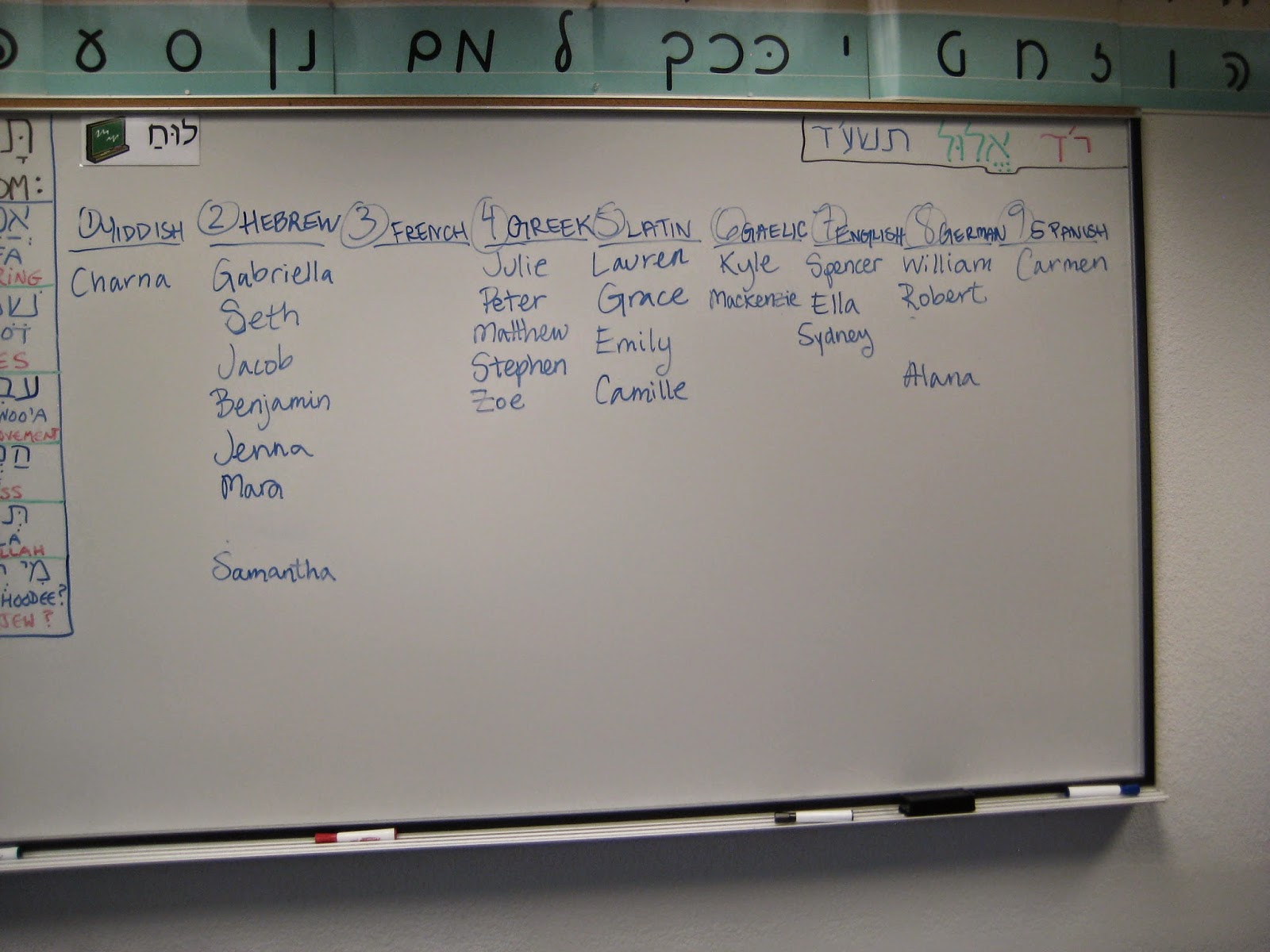
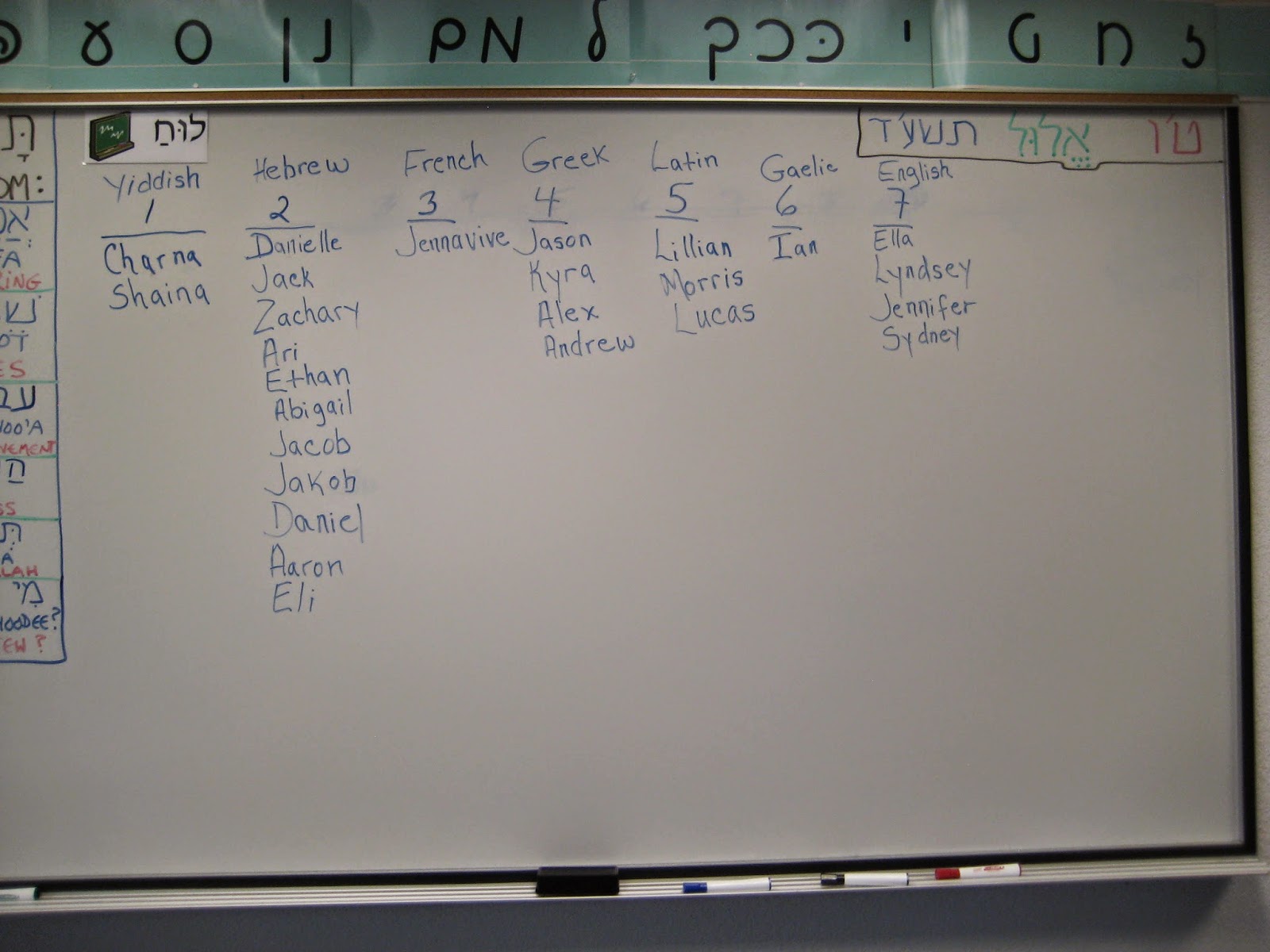
Since we are still getting to know each other, I began our week day sessions by going around the room, asking each student to share his or her first name. As the students were sharing their names, Julie (my Tuesday co-teacher) and Donna (my Wednesday co-teacher) wrote the name on the whiteboard, under certain column headings. The students were asked to try to determine the pattern of the columns. There were nine different columns, and at the end of the exercise each day, several students recognized that each column represented a different language of origin of the name.
Tuesday's students and...
Wednesday's students. We labelled the columns after the students discerned the pattern.
Now that we determined that our first names represented languages from areas around the world, the next obvious question to the students was, "If we are all Jewish, why aren't all our names listed under Column #1 (Yiddish) or Column #2 (Hebrew)? Most of the students were familiar with the fact that Jews have lived and continue to live in many parts of the world, and that we have borrowed elements from the cultures around us, including names. With that in mind, my next question was, "If Jews live everywhere in the world, how can you tell that someone is Jewish?"  This was a question which I asked the students to consider at home, before school began, and from the discussion that ensued both days, it was obvious that many had carefully considered this question.
 There were lots of ideas to share!
By the end of the discussion, we had determined that to be Jewish means to be a citizen of the oldest nation on Earth today. We also determined that many Jewish citizens are followers of the religion of the Jewish nation - "Judaism." Since the definition of a nation is "a group of people with four attributes in common: language, land, laws, and history," we fit into the definition of a nation. But because of our unique history, having been exiled from the Land of Israel for almost two millenia, the Torah and commandments became our common bond. In order to ensure the continuation of our nation, as is the case for any nation, it is imperative that each generation teach the next one aspects of the four national attributes - connection to the Land of Israel, an awareness of the laws - commandments - of our nation, an awareness of our historical roots, and some knowledge of our Hebrew language.

And speaking of our Hebrew language, we began our Hebrew Through Movement sessions this week. Most of the students have been involved with this program for three years, and I was amazed by how much they recalled after our long summer break. Here's a little peek at one group of girls following my Hebrew commands without any review at all:


Just imagine how much Hebrew our Edot students will be able to understand by the end of this year! Not to mention Jewish history, laws relating to the holidays and prayers, and hopefully a better understanding of the connection of the Jewish People to the Land of Israel. Good, upstanding citizens of the oldest nation on Earth!


Sunday, September 7, 2014

B'ruchim Ha'ba'eem - Welcome Back Everyone!

Has there ever been a summer that hasn't flown by too quickly? Hopefully, you've all enjoyed the summer break, and, judging from the energy and enthusiasm I saw and heard in class today, it seems that our Edot students are ready to begin a fun-filled learning adventure together.

It was wonderful seeing everyone at the pancake breakfast and at tefillah this morning - greeting old friends and meeting new ones. Once the students and I entered the classroom, we wasted no time in getting to know each other better. The "Nametag Matching" activity which I planned was a big success, in that it gave everyone a chance to learn each other's names and find out a bit about each other's interests.

After choosing a colored index card, each student was asked to find the label with his/her first name on it, and attach it to the center of the card.

I then asked the students to write certain of their favorite things to do, favorite singers/bands, favorite movies, and a couple of positive adjectives describing themselves - each in one corner of the index card.
 Once everyone had written down the above, they shared with each other by finding other students at the table who wrote similar interests, as well as different interests down. They introduced themselves then shared why they wrote what they did. I couldn't have hoped for better results - listen to the sounds of sharing:


Following this "getting-to-know-you" activity, I introduced the Shekel Game to our new Edot students. Those students who were in my class this past academic year know the game very well. We'll be playing it at the end of each of our major units of study - it's my way of finding out if there are any important pieces of information I've shared during the unit which most of the students can't recall. You can be sure we'll review it after the game!

Now that everyone has had a chance to get to know each other better, it's time to huddle to figure out the answers to the questions in the Shekel Game. The questions this time came from material taught in the third/fourth grades.
Using play Israeli currency (Shekels), the group bets a certain amount that it can correctly answer the question I ask in certain categories - today the categories were "Hebrew Through Movement," "Prayerbook/Blessings," "Holidays," and "Torah." Only the reporter can give the answer, but a lot of discussion about the correct answer goes on before the 30 seconds they are given to figure it out are over.
Almost all the questions were answered correctly, and even more importantly, everyone had a good time.
Thank you to my wonderful co-teachers and TA's for their invaluable help today, and throughout the year. Josh C. will be my co-teacher first session every Sunday (unfortunately, Josh was feeling under the weather and couldn't join us today - he'll join us next Sunday); Kimberly K. will fill that role second session (Kimberly is also our First Grade teacher during the first session). Michael S. and Tanner L.will be our first session TA's; Isaac D. and Jacob P. will help out second session. During the weekday sessions, Anna B. will be my TA on Tuesdays; Max K. on Wednesdays.

We have so many fun and informative activities planned for the year. This coming week I'll introduce our first unit of study in the Edot class, the American Jewish community. Our culminating activity for this unit of study is a field trip to Sonora and Columbia State Park in November, where we'll learn about the Jewish pioneers of the Gold Rush. Stay tuned for a letter you'll be receiving very soon with details about the trip.