Monday, October 10, 2016

The Golden Land

I introduced our first unit of study to the Edot students yesterday morning - the American Jewish edah - by  sharing a video segment from the "Heritage: Civilization and the Jews" dvd-rom program, in order to help bring to life the first 200 of the 350+ year experience of Jews in the "Golden Land." You can view the video here. (I played the segment beginning at 5:07 and finished at 17:45.)

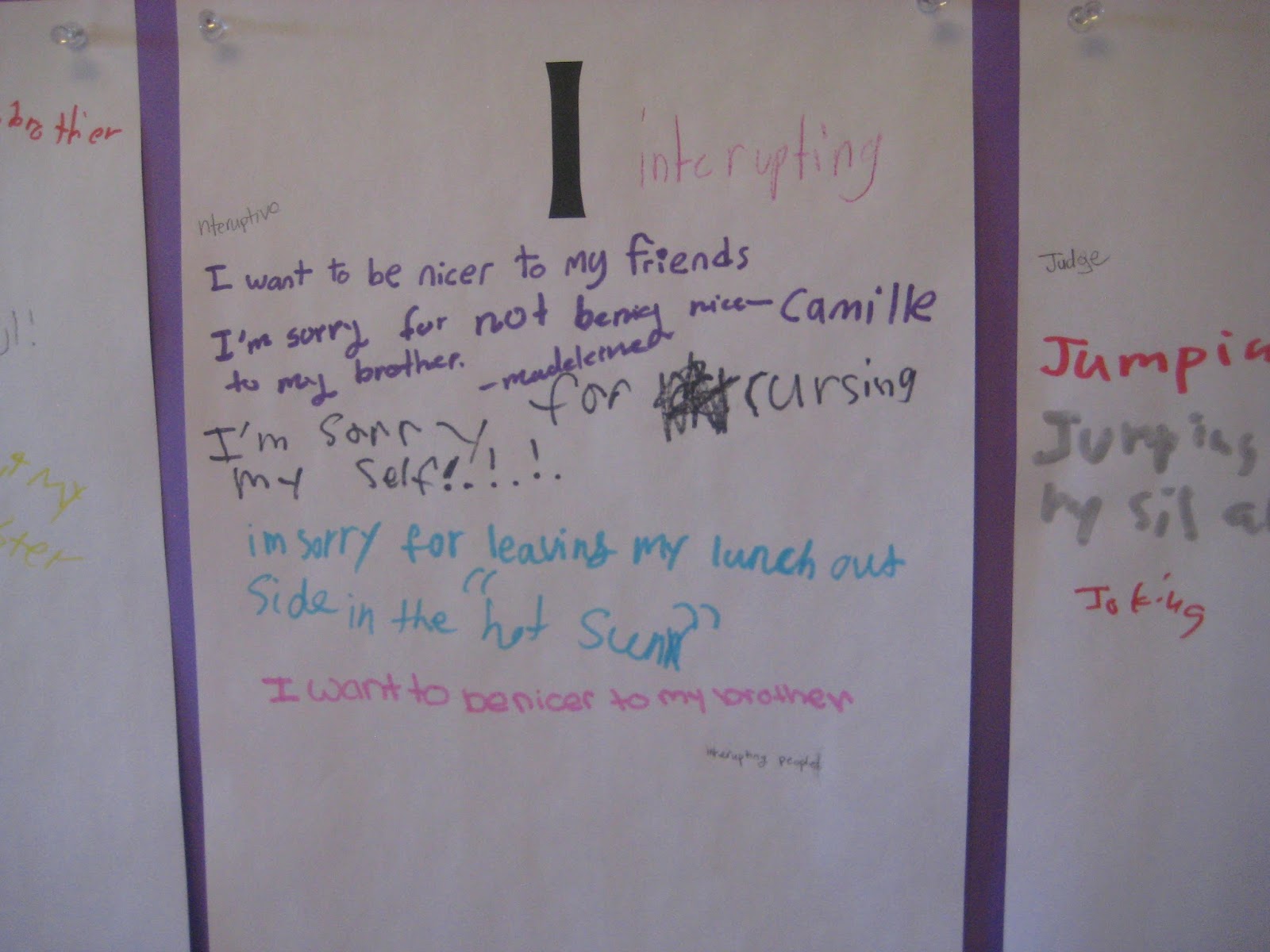
Since yesterday was the 7th day of Tishrei, we focused a good part of the session also on Yom Kippur (which begins tomorrow evening at sundown). We had discussed the concept of "t'shuva" (atonement) in class just prior to Rosh Ha'shana. Now, we focused on the "Ashamnu" prayer, the prayer we recite on Yom Kippur together as a community, asking forgiveness for our sins. The prayer is an acrostic, in which our sins are recited in the order of the Hebrew alphabet. In order to provide our 3rd through 6th grade students an opportunity to ask for forgiveness, Rabbi Greninger had 26 posters hung up on the walls of our school building's upstairs hallway - each piece had a letter of the English alphabet printed on its top margin. The students were then asked to write a "sin" - something they were sorry they did or thought during the previous year, beginning with the letter of the alphabet at the top of the page. I found it interesting that many of the Edot students found it hard to think "in the negative." Instead, they wrote positive messages to themselves on the posters of how they would improve their conduct.

This,  in my opinion, was a particularly powerful statement
We had our second session of music with Revital and Michaela and the other 5th and 6th grade students at the end of each session yesterday.
Using the powerful song sung on Yom Kippur called "Pitchu Li Sha'arei Tzedek" ("Open for me the Gates of Righteousness"), Revital taught us how musicians through the ages have used the "melismatic" form of compositions, where several notes are assigned to one syllable of a lyric in order to give a more emotional tone to a song.   
G'MAR CHATIMA TOVA - MAY WE ALL BE SEALED FOR A GOOD YEAR!

Friday, September 30, 2016

Honey Cake

This past Tuesday and Wednesday, our Edot students joined the Shira and Y'tzira tracks for the first of 8 cooking sessions planned for this year. Karen taught the session on Tuesday, and Stephanie led it on Wednesday. We prepared honey cake, since this coming Sunday evening we begin our new year of 5777. And there's nothing better to begin the new year with, than a sweet and delicious honey cake!

We met in the Oneg Room, up in the Sanctuary building, and as soon as we entered, found tables set with all the ingredients and tools needed to prepare the honey cake. Thanks to the convection ovens in the kitchen, the cake was ready for all to enjoy by the end of the JQuest session each of the days!

Below are some photos of our Edot students in "cooking action" with their fellow Shira and Y'tzira students:

SHANA TOVA U'M'TOOKA! (A GOOD AND SWEET YEAR!)
L'SHANA TOVA TIKATEIVU (MAY YOU BE WRITTEN FOR A GOOD YEAR)

Sunday, September 25, 2016

Balancing on the Timeline

This morning in both sessions we began to focus on the coming 10-day period of the Yameem Ha'nora'eem - the Days of Awe (also referred to as the High Holy Days). These are the 10 days between Rosh Ha'shana (Jewish New Year) and Yom Kippur, a period of introspection both for individuals as well as for the community.

“Awake, you sleepers from your sleep. Arouse you slumberers from your slumber and ponder your deeds; remember your Creator and return to the right path. Look well to your souls and consider your deeds; turn away from your wrong ways and improper thoughts.”  We discussed what this quotation from Rambam - Rabbi Moses Ben Maimon (a/k/a Maimonides) might mean for a bit. Then I asked the students to listen carefully to certain sounds played from my computer,  to see if they could figure out what the sounds had to do with the quotation.

All the students recognized the sound of the shofar immediately. We determined that the shofar, according to Rambam, is an alarm clock which we set each year to "wake" us from a deep sleep (forgetting to "do the right thing"). I then explained that each sound that we make on the shofar has a meaning and purpose - originally, one of the uses of this ancient instrument was to sound an alarm in times of danger. The word "shofar" itself is built from the Hebrew root letters 'shin-fey-resh.' All the words built from this root must have something to do with "improvement." The names of the three sounds we make with the shofar, tell us what needs to be improved: t'roo'a (9 staccato notes) comes from the root letters 'tav-resh-ayeen' and means "alarm." We are being warned that there is a dangerous situation afoot. Sh'vareem (3 short notes) is built from the root letters 'shin-vet-resh,' and means "broken." Something is broken. The third sound's name, 'tekee'a' is built from the root letters "tav-koof-ayeen" and is related to the word "teekoon" meaning "repair."
Alarm-something is broken-repair. The shofar's sounds are "waking us up," reminding us that we are here to be God's partners in doing our best each day to "balance on the timeline" - to do our best to make the world a just (fair) place to live. To achieve this goal, we are asked by Talmudic era rabbis to follow the commandments and do good deeds for ourselves and fellow human beings, for the environment, for all of Creation, in order to create a just universe. Once every part of Creation is in balance, they taught, time will end and we will enter the Messianic Age, or Absolute Time as they termed it. Time's purpose will have been served, and time will disappear to allow us to exist in the dimension of Absolute Time, in which God exists.

From this point on, the students will see me every now and then "balancing" myself on the timeline, as we discuss how and why the different edot (Jewish Diaspora communities) never gave up on maintaining a strong Jewish identity no matter what their circumstances.

Once we had established that we are expected to maintain our balance by following the commandments and doing good deeds, I opened up a discussion about what happens if you don't do so. What, I asked, happens, if we "lose our balance, and fall off the timeline?"  At this point, I introduced the Hebrew word/concept of "t'shoova," which is usually translated as "repentence." Literally, the word means "return." If we lose our balance, and realize we are falling off, we have a chance to "turn around", to get back on the timeline. How do we "do t'shoova" - how do we return? To help answer this question, I introduced the students to 4 case studies of people who had, indeed, "fallen off." At the end of each case, I asked, "do you think this person has found his/her way back to the timeline? From the case studies, the students determined there were 4 steps that had to be taken to "do t'shoova":

1. Realize you've lost your balance - that you've done something wrong.
2. Ask forgiveness from  yourself and from the person/people you've hurt.
3. If possible, correct the specific situation that you "lost your footing" over.
4. Make a plan to avoid the same situation, or how to react if the situation should arise again.

Once we established these 4 steps, I informed the students that if a situation arises in our classroom where someone has "lost their balance" and won't respond to two warnings that I'll give them, I'll ask them to write a "t'shoova essay." Very simply, the student will be asked to go home and think carefully about why they were assigned the essay, then write a sentence or two for each of the 4 steps. This "essay" will be his/her ticket back into the next session of our classroom. I'll keep the "essay," and if the situation arises again, I'll ask the student to re-visit the 4th step, and find a solution that will work. I want each student to take responsibility for his/her own actions, and to become aware when those actions can sometimes be disruptive to others around them.

During our HTM (Hebrew Through Movement) session, I introduced the term "leet'ko'a shofar" (blow a shofar), and we had fun with the shofar itself and with trying to blow the three different sounds we listened to earlier in the session.


Here are the sounds of the shofar that we listened to in class today. Just one week from this evening, we'll be greeting the new year - Rosh Ha'shana - as a community with those sounds. Let me take this opportunity to wish you all "Shana tova u'm'tooka" - a good and sweet year, 5777. A year of good health and success at balancing on the timeline!  "L'shana tova teekateivoo" - "May you be written for a good year."

Monday, September 19, 2016

Who Was Emma Lazarus, and What Made Her Famous? It's a Stumper!

Yesterday, I introduced the students in both sessions to an optional program that I've been running in my classes - the "Stumper/Challenge" program. Many years ago, I finally came to grips with the fact that a religious school setting was not going to provide the time I wished for, to share aspects of our wonderful Jewish world with my students that we don't have time for in our curriculum.

Instead, I developed an incentive program (the incentive being a $10.00 Toys 'R Us gift certificate) which would allow the students who participated to not only learn about what is happening in the Jewish world, but to become teachers and spread what they learn with their fellow Edot students. The program works as follows:

There are sentence strips hanging on the bulletin boards and walls of our Edot classroom, each with a stumper question or challenge written on it. At the top of the strip is the category for the stumper/challenge - "Jewish World," "Holidays," "Jewish History," "Israel," or "Tana'ch" (Hebrew Bible).

The stumper questions may have something to do with what we're studying, or not. In most cases, the stumper question is hanging close to a newspaper article or printout from the internet in which the students can find the answer. I've even made it easy for them to find the answer in the article, by highlighting in yellow important parts of the article, including the answer itself.
There are some questions the answers to which are found in books in our classroom - for example, many of the holiday stumper questions are taken from the "All About Jewish Holidays and Customs" book standing on our window sill. There are also worksheets hanging on the wall (especially in the holiday section), for which the students can receive credit toward the gift certificate.
When a student believes s/he has found the answer, s/he lets me know (out of earshot of the other students), and if the  answer is correct, s/he receives one sticker from me (currently I'm giving out dreydl and menorah stickers). These stickers are placed on a clean sheet of paper, with the student's full name at the top, and is kept in the student's folder on our counter.
Some sentence strips have challenges written on them, which take more time and effort to answer - for example, under the oval Hebrew calendar chart on one wall, is the challenge to memorize the 12 Hebrew months, beginning with the month of Tishrei in which we celebrate the High Holy Days. If a student succeeds with a challenge, s/he receives 5 stickers.
Once a student has accumulated 20 stickers, s/he earns the gift certificate, and can begin to collect more stickers toward another gift certificate - there is no limit to how many gift certificates a student can earn during the school year.
There is one more way to earn stickers - writing a book report. I have a page of detailed instructions on the counter in the classroom, if any student would like to write a one-sided, typewritten report. The report is worth 10 stickers, and I will accept up to 4 book reports from each student per year. At the end of the year, I photocopy the reports, and hand them out to all the Edot students to take home as an annotated summer reading list.

How do the learners become the students, you may ask? Once a student accepts a sticker for correctly answering a stumper question, s/he agrees to become a teacher for that question. If another student asks if s/he has answered a particular question, and s/he has, s/he is required to share the answer with the second student. If for some reason s/he can't recall the answer, s/he can come to me and I will check the chart I keep of which stumpers each student has answered, and if, indeed, the student has answered the question already, I'll remind her/him of the answer to share with the second student. This is my sneaky way of exposing the students to as many aspects of our amazing Jewish world as possible in the little time we have together.

I have told the students that they can answer stumper questions before class (if they arrive early and I'm in the classroom), during hafsaka (recess), but never after school, since our traffic situation is complicated and I don't want to have parents waiting for their children and holding up the line. The students are also very welcome to call me with a stumper answer or to e-mail me. If you don't have my phone number and/or e-mail address, please call Daniella in our JQuest office and she'll share them with you. Challenges do have to be done in person in front of me, since so many require memorization or pointing to a chart in the classroom.

Since I change the stumpers and challenges every 5-6 weeks (usually when we finish a unit of study, and more frequently to match the holidays), I've promised this year to make use of my blog to post the questions and challenges and keep them updated so that the students can refer to the questions even when they're not in class. Even after I remove a stumper or challenge from the wall, a student is welcome to answer or perform it until the very last week of school. You'll find a list of the current stumpers and challenges at the end of this post.

At the start of each session yesterday, I introduced the historical novel that I'll be reading the first 10-15 minutes of each weekday and Sunday session during our first semester - "Out of Many Waters" by Jacqueline Dembar Greene. It is a wonderful introduction to our first unit of study - our very own American edah. It is the first of two books written by Ms. Greene which share the Sephardi (Spanish/Portuguese Jewish) experience during the Spanish Inquisition period; the first book, which I'm reading to the students, shares the story of how the first permanent Jewish community in North America was established in 1654, in New Amsterdam (present day New York); the second, called "One Foot Ashore," shares the story of the exiled Sephardi community in Amsterdam. I won't have time to read this last book in class, but I highly recommend it to my students. If any of them would like to write a book report about it, I have a copy to lend from my classroom and our Isaiah library has a copy as well!

We continued yesterday to have more fun with our Hebrew Through Movement program, reviewing more basic command vocabulary: (na = please; l'heestovev = turn; la'atzor al yad = stop next to; keer = wall; yafeh = nice; achshav = now; l'hatzbee'a al = point to; mapa shel yisrael = map of Israel; rosh = head; la'seem = put; yad = hand)


At the end of each session, we had our first music lesson with our new JQuest music director, Revital, and her music aide, Michaela. They had us play games this first session, to help us learn to sing a melody silently in our heads to improve our focus. We sang the "Oseh Shalom" prayer out loud first, then were asked to sing it silently and only sing three words out loud when they came up in the melody - "shalom," "yisrael," and "amen" and then, a second time singing out loud only the words "oseh," "ya'aseh," "aleinu," and "kol."
Revital is standing on the right, Michaela on the left; we're scheduled for a 15-minute music lesson every couple of weeks, together with the other two 5th/6th grade tracks.
During our t'fila (prayer) service between the two sessions, we listened to Rabbi LeVine sound the shofar (Jews all over the world are required by Rabbinic law to listen to the sound of the shofar each day except for Shabbat during the entire month of Elul). Rabbi Greninger finished the service by having us all stand and sing the Israeli national anthem, "Ha'tikva." We will  try to end each Sunday service with the anthem. When you click on the link to the "Hatikva" above, I hope you'll have a chance to listen to the recording made of Bergen-Belsen survivors singing the anthem on April 20, 1945. It's very moving!


STUMPERS AND CHALLENGES:

Jewish History/Jewish World Stumpers:
Who was Emma Lazarus and what made her famous?
What was Harry Houdini originally named?
Name 3 things that Haym Salomon did to help the U.S. become a free nation.
How many Jewish grave sites are in California's Gold Rush country?
Who was Louisa May Alcott descended from?
To which U.S. state did many Jews flee in the late 1400's, and why?
What patent did Levi Strauss take out for his "gold miner's" pants?
Where did Jewish peddlers get the things they sold?
What did the ship agents promise those who traveled to California during Gold Rush days?
Give one reason Jews became cattle farmers in California's Gold Rush country.
What did Barbra Streisand's grandfather do for a living?
Who was Uriah P. Levy, and how did he help preserve U.S. history?
 
Holiday Stumpers:
Why are we not allowed to blow the shofar on Shabbat?
How might you not fulfill the mitzvah of "hearing" the shofar?
The Talmud says, "Intelligence, not work." What does this have to do with blowing a shofar?
Name the major Jewish holidays which fall in each Hebrew month.
When and why did the Kol Nidre prayer come to have a greater and deeper meaning for Jews?

Calendar Challenge:
Memorize the 12 Hebrew months in order, beginning with Tishrei.

Israel Stumpers:
What is "Jerusalem Fever?"
Who is Israel's current Prime Minister?/current President?
What is the Knesset?
What is "Birthright Israel" and why is it so important?
Why was there a music "renaissance" in Israel during the 1990's which continues to this day?
Who are the peoples who live in Israel's borders with the Jews? 

Tana'ch Challenge:
Name all the 13 tribes of Israel. (Yes - 13! - Jacob had 12 sons, but his favorite, Joseph, did not have one tribe named after him;  instead, he had 2 tribes named for his 2 sons - you get an extra sticker if you can name Joseph's two sons!)



Monday, September 12, 2016

B'roocheem Ha'Ba'eem La'Edot (Welcome to the Edot)

The words in the title of this post were written in large letters on our Edot classroom white board. "Blessed are those who arrive (or come) to the Edot" is the literal translation from the Hebrew. I had the great pleasure yesterday morning of welcoming our new Edot students and saying "hello" again to returning students.

We started the morning both sessions with a welcoming breakfast/brunch, where all the students received a new JQuest T-shirt. With the light blue staff T-shirts, the green Avodah TA T-shirts, and now the dark blue student T-shirts, our JQuest gatherings are becoming quite colorful!

Students and their parents looked for the grade or track they had registered for around the perimeter of the Social Hall, and there they were greeted by their teachers and Avodah TA's who signed them in and gave them a name tag and a JQuest T-shirt.

Families had half an hour to enjoy breakfast and schmooze with other families, then it was time for parents to join Rabbi Greninger in the Sanctuary to learn about our Hebrew program, while the students followed their teachers down to the classrooms.
Once in the classroom, we began to get to know each other by creating name cards with notes about our favorite movies, singers, things to do for fun and two adjectives describing ourselves in a positive way. Then we shared what we had written for each category, and found others in the class who had similar interests (we have a lot of athletes in our class in soccer, baseball, basketball, water polo, tennis and lacrosse!) These cards will be hung on the wall over the windows in our classroom, together with a photograph of each student.
And once we had gotten to know each other a bit better, we played The Shekel Game - a betting review game that lets me know after each unit of study how much information the students have retained while they are having fun betting that they can correctly answer the questions I give them in different categories. The categories in yesterday's game were Hebrew Through Movement, Siddur (Prayerbook), Jewish Holidays and Torah.
We only played for a few minutes, to allow the new students to learn how the game is played, but it was plenty of time for me to get a sense of how much they remembered from the previous year - especially in the Hebrew Through Movement category. As you can see in the video below, the program is a great success. After four long summer months, see how quickly the boys in the group reacted to my Hebrew commands!


Between the two sessions we held an all-school tefillah (prayer service), where we welcomed in our new JQuest school year with a "tekee'a" blast of the shofar by Rabbi LaVine, our new Assistant Rabbi at Isaiah.


And to end the service, we sang the Justin Timberlake song, "Can't Stop the Feeling" with new lyrics written by our own Rabbi Greninger. While we sang, we watched the original video of the song with a few extra cast members dancing to the tune - our teachers! A big YASHER KO'ACH goes to Erin for the amazing editing job, and of course to Rabbi Greninger for the "Starting JQuest @ Isaiah" lyrics. Here's a little snippet of the video with yours truly and Rabbi Greninger dancing to the song:


As Rabbi Greninger's lyrics proclaim, "It's a journey, it's a journey, it's a journey...Gonna be a Jewish journey...."

OUR EDOT JOURNEY IS ABOUT TO BEGIN - A JOURNEY THROUGH TIME AND SPACE. 
First stop: New Amsterdam, 1654 C.E. Pack your bags and hang on to your britches! It's a wild ride into the Wild West!

Monday, May 16, 2016

Spring Fling

And so, our final day of JQuest this school year arrived yesterday - our Spring Fling! The weather was perfect for all the activities of the day.

First, we met together one last time in our classroom. The hour we had together flew by. I continued reading two more chapters from "A Shout in the Sunshine" which I'd been reading aloud to the students since February. We didn't have enough time to finish reading the entire book, so I read the chapters then summarized the rest of the story. The focus of the book is on what happens when two very different cultures (the Sepharadi -Spanish Jewish and Romaniote - Greek Jewish) are forced to live together because of the political situation of the time (in this case, the late 15th century, following the Spanish exile). There is a definite parallel to what is happening in our own times, with refugees streaming into Europe from the Middle East and Africa.

As soon as I had finished summarizing the book, we got ready to play our final Shekel Game of the year. As always, I was very impressed at how much information the students retained. In this game, the material for the questions came from everything we had studied since September in Hebrew, Siddur (Prayer book), Holidays, Jewish History and Edot. The students take the game very seriously, even as they're having a lot of fun deciding how many shekels to bet on whether they can answer the question correctly.

Sammy is sharing what he's sure is the correct answer, and it was!
Let's see how much money we have - we can't bet more than half the amount we have!
The group has 30 seconds to answer the question after I've asked it.
Kyra is the recorder - writing down how much the group bets, so there's no question about the amount when it's time to pay them for answering correctly!
Hmmm - still mulling over the answer.
And while we played, those students who were absent during the previous weekday session had a chance to thank Rabbi Graetz for all he's done for our Isaiah community over the past quarter century on the card we made for him.
We finished the game, then went upstairs to the Sanctuary where all the other classes were gathering, and where many of our Edot students joined their parents. Once everyone had settled down, it was time to honor the volunteers, teachers and TA's.

Here, we're honoring the TA's.
And here are the teachers, minus one (I'm taking the photo!). (Notice the screen above - just before the concert began, the Shira track's music video was screened. Yasher Ko'ach to Erin and all her Shiraniks on an amazing project!!!)
Special thanks went to Jory, who is leaving JQuest to travel through South America next year.
And then it was time for our special honoree, Rabbi Graetz, to come up front. Rabbi Greninger spoke for all of us when she thanked him, and then presented him with a large bag filled with cards and special gifts made by each class.


As Rabbi Graetz carried his "treasures" back to his seat, Billy Jonas and his band began to perform. He uses all sorts of interesting instruments, and best of all, had us all join in for every song! Below, he's leading us in singing, "Who's Gonna Make Our Music?"


The concert lasted a good part of an hour, and then it was time for everyone to move to the Social Hall, where Bill and his crew had tables ready, brimming over with barbequed hamburgers and hot dogs and all the fixings. 

Amazingly, there was plenty of food for everyone!

The room filled quickly. Once you filled your plate, you could eat at a table inside, or...
...you could find a seat at a table outside, enjoying the glorious weather.
Inside, Cantor Korn led our Kleztone musicians in concert.
Here's our own Sammy playing the dumbek (Yemenite drum).
It's obvious the Kleztones have their own fanbase - and possibly a future member or two!
And outside, there was plenty of action in the funhouse...
...and playing Gaga (there's Ariston heading toward the ball!).
And so the 5776 school year is ended. Have a wonderful summer, and I'll look forward to seeing my students - past and present - on Sunday, September 11th, when our 5777 JQuest year begins (about 3 weeks before Rosh Ha'Shana, when 5777 itself begins!). 

L'HITRA'OT! (AU REVOIR!)

Thursday, May 12, 2016

Yom Ha'atzma'ut

Today is Israeli Independence Day - Yom Ha'atzma'ut. We are celebrating the nation's 68th birthday. To celebrate this joyous occasion, I shared a 20-minute segment of the final video in the "Heritage: Civilization and the Jews" program ("Into the Future") during our weekday sessions, which presented the history of the modern Zionist movement, the struggles the new state had to endure from its outset, and how members of 70 different edot (Jewish Diaspora communities) made their way on their own or (especially in the case of Jews living in Arab countries) with the help of the Jewish Agency in Israel. This was the perfect summation of our edot studies this past year - sharing how the absorption of so many Jewish immigrants over the past 6 decades from all over the world has created a unique Israeli culture and has brought to realization the 2,000-year old dream of the Jewish People - "Next Year in Jerusalem!"

These past weekday sessions were busy for us. Aside from celebrating Yom Ha'atzma'ut, we also prepared a special card for Rabbi Graetz, to wish him well on his retirement. Since many of the children in the class have not had the opportunity to work with Rabbi Graetz individually, I decided to conduct a mini-lesson on the roles a rabbi plays in a congregation before introducing the card activity to them. We learned that a congregational rabbi not only serves as officiator at Jewish life cycle events, and not only leads the congregation in holiday and daily prayer services, but also serves as a role model for how to lead a fulfilling Jewish life and how to feel proud of our Jewish identity. The rabbi also serves as a counselor/social worker in many ways, helping congregants deal with personal issues and helping to unite and strengthen the congregation's community. Once the students realized how much Rabbi Graetz has contributed to our Isaiah community, they were ready to write their own special remarks to Rabbi Graetz on the card. The card will be presented to him at our Spring Fling, this coming Sunday.

I printed the photos of every Edot class student on one side of the card, with each student's first and last name printed underneath.

Some of the artists in our class volunteered to illustrate the front and back sides of the card.
Students drafted their wishes and thanks for Rabbi Graetz on scrap paper first, then copied them onto the card with markers, being sure to sign both their first and last names, so that Rabbi Graetz could match the faces with the names.
Students shared ideas with each other about what to write.
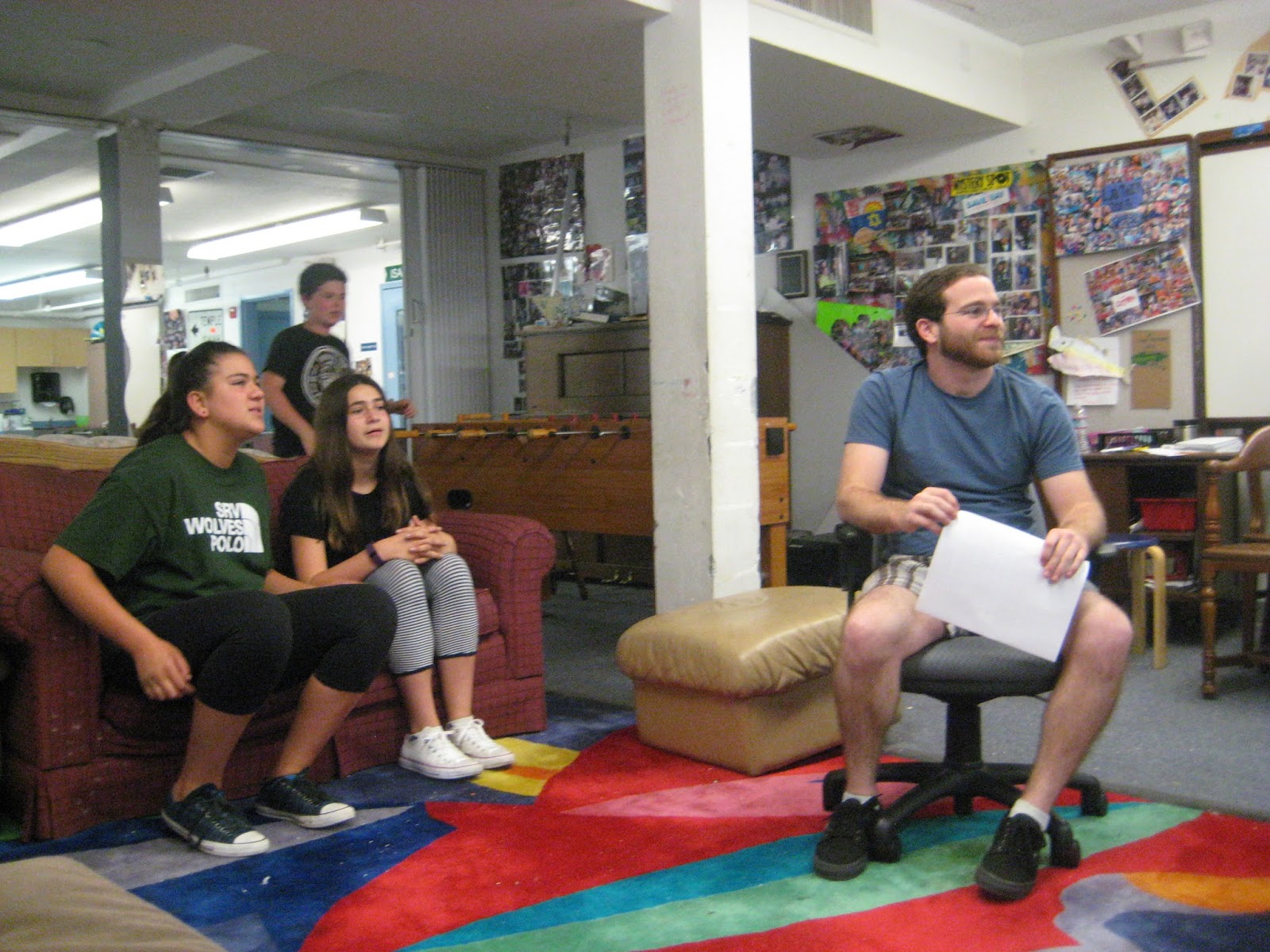
During our usual tefillah time, from 4:30 to 5:00, the 6th graders met with Jory, our 7th grade coordinator, in the Youth Lounge in the basement of the Temple House Building. There, Jory shared with them what they could expect as 7th graders - what they would learn, community service projects they'd be involved in, a class trip to Los Angeles during the MLK, Jr. Birthday weekend in January of this coming year, and performing tikkun olam (repairing the world) through the 7th Grade Fund program. We then all moved to one of the classrooms near the Youth Lounge, where Jory led the students in a "Clock Game," requiring them to work together as a team to figure out a solution to how to move around in a circle to different "times" posted on the 4 walls of the room as quickly as possible. I was impressed at how quickly (though very noisily!) both the Tuesday and Wednesday sessions worked to find a solution and succeeded.

Getting comfortable on the sofa in the Youth Lounge
Jory sharing what they'll be doing as 7th graders
Playing the "Clock Game" in the classroom
As many of you know, Jory will not be returning to teach at JQuest in September. We wish him well for his plans for traveling through South America next year, and in all his future endeavors.

I look forward to seeing as many of our Edot families as possible at our Spring Fling on Sunday. Remember that both sessions will meet in our classroom from 10 to 11 a.m.. Then we'll go up to the Sanctuary for the Billy Jonas concert, and finally enjoy a barbeque with lots of fun and games.

YOM HA'ATZMA'UT SAMEACH! HAPPY 68th BIRTHDAY TO ISRAEL!