Thursday, March 22, 2018

Matza Apple Tea Cakes

These past two weekday sessions we met up in the Oneg Room with Karen to learn how to make a wonderful Pesach treat - Matza Apple Tea Cakes. These are perfect snacks or even part of a meal for the holiday (which begins this year on the evening of March 30th, just a little over a week from now!).

As usual, we started the session each day by gathering around the demo table where Karen shared kitchen secrets about the best way to slice apples.
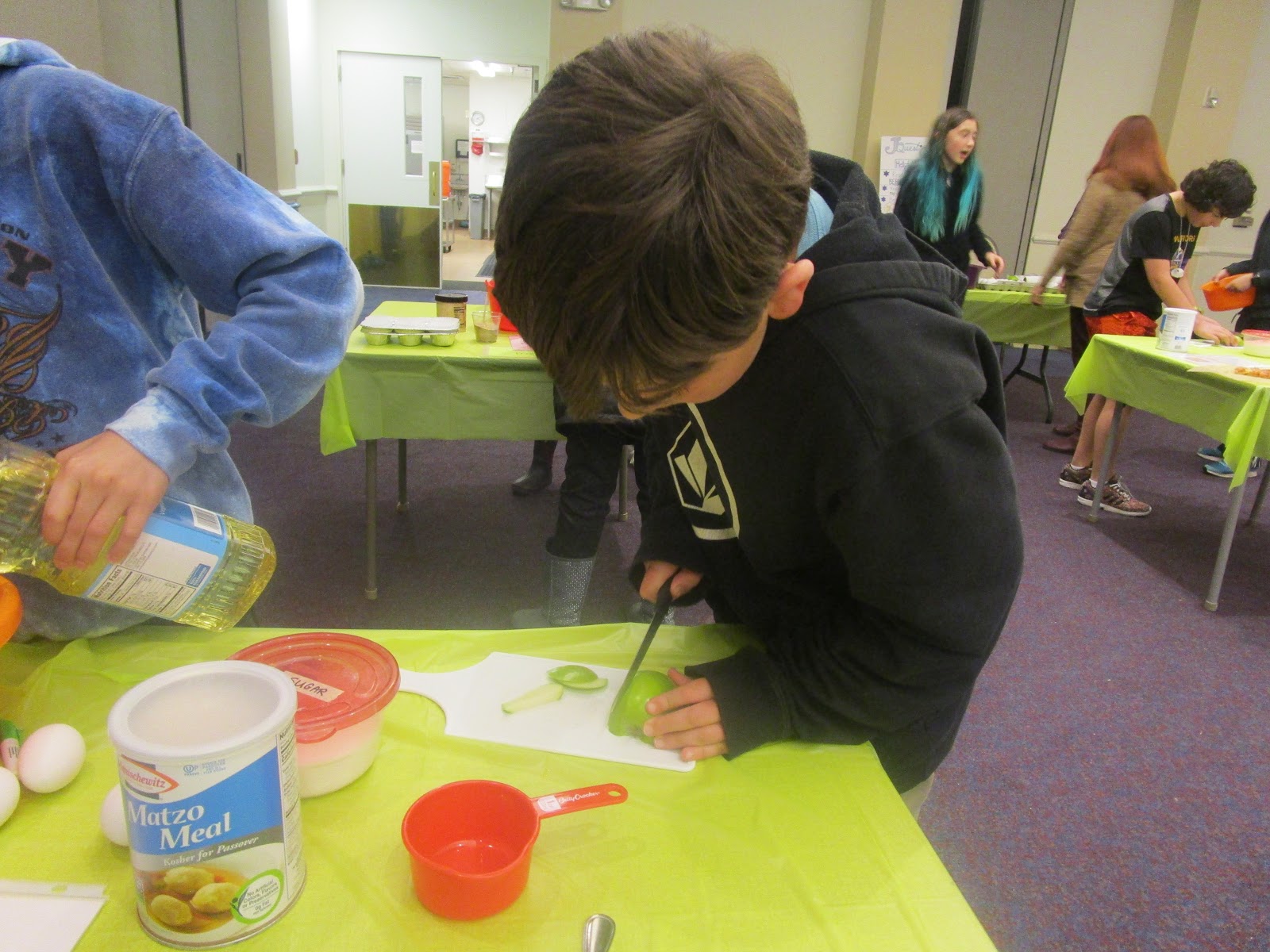
Then it was time to start slicing. As it turns out, Granny Smith apples have tough skins, and are not the easiest apples to slice into small pieces.
Thankfully, Karen's tips were put to good use. 
And even then, it took two students at each table half of the session to slice both apples into small enough pieces to put into the batter.

Meanwhile, two other students were preparing the batter. First, you added in the oil.
Then it was time to measure out the matza meal ...
...and add it into the bowl - but not before looking up and giving a big smile for the camera !
Some students teamed up - one pouring the matza meal into the measuring cup, while the other carefully held it then poured it in.
As you can see, there was a lot going on at once at each table.
Once all the batter ingredients had been put into the bowl, it was time to add in the apple pieces.
Then it was time to stir (with a big smile!) ...
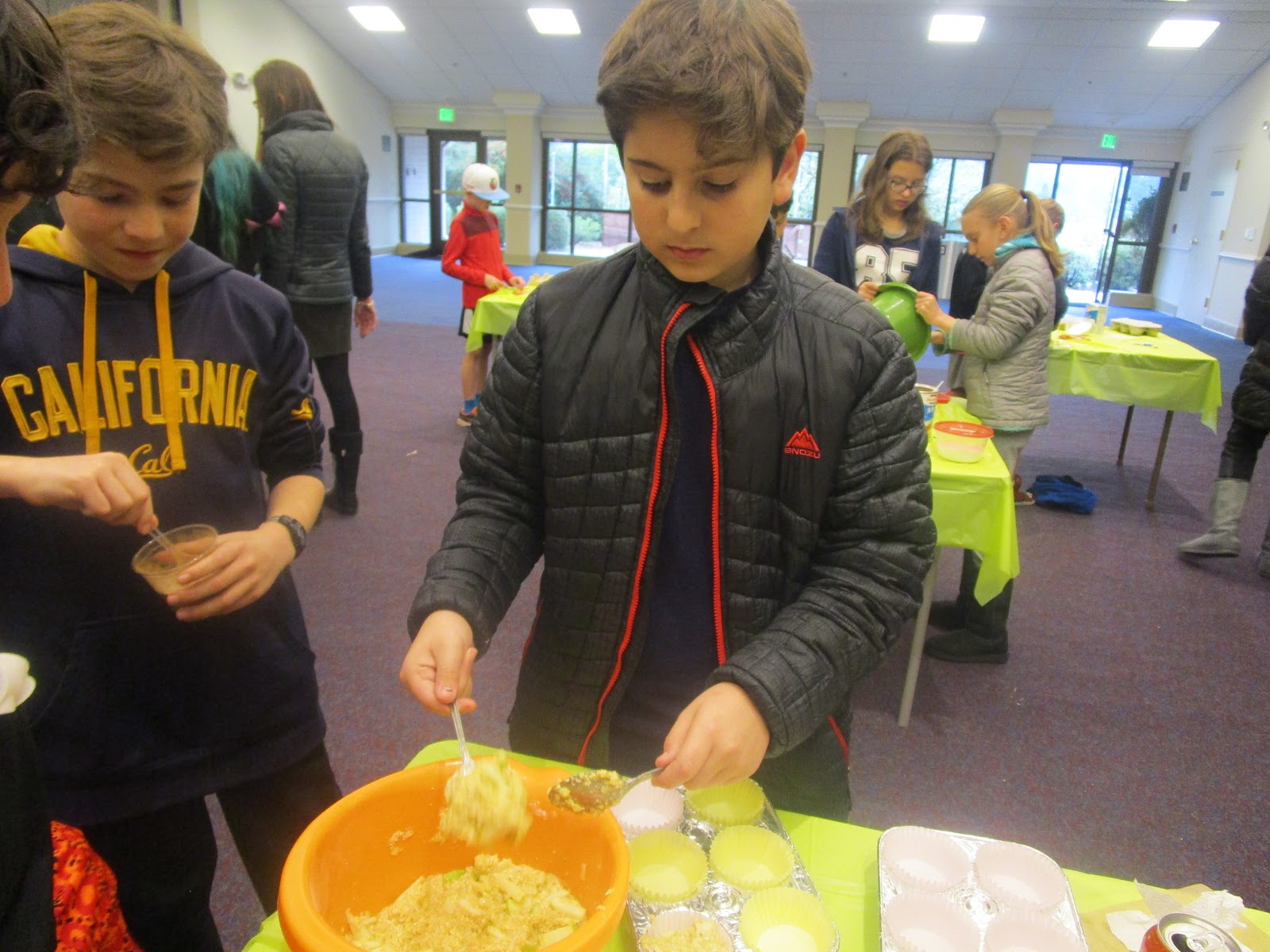
Paper cups were arranged neatly in the muffin pans ...
... and the trickiest part of all was spooning the finished batter into the paper cups without spilling it all over the table.
This was accomplished very well with a lot of team work!
Once the paper cups were filled 3/4 of the way up, it was time to sprinkle cinnamon sugar on top of them. Some students used their fingers to sprinkle the sugar ...
... while others used a teaspoon to do the job.
Our half hour cooking session sped by as it always does, and everyone had a chance to taste the baked tea cakes just before going home. In our Edot class, there was a unanimous decision that these were so delicious that it was hard to eat just one! Luckily, we send out the recipe to all the parents, so I'm hoping you all have a chance to prepare these together at home and enjoy them.

Following our weekly tefillah service and indoor recess (it had begun to rain again), we reviewed what we had learned to date about the Jews of Spain, then I introduced a writing assignment which each student completed before the end of the session. I asked them to write two paragraphs for which they had to imagine that they were Crypto-Jews living in Saragossa, Spain in the year 1591 (several generations after Jews had to choose between converting or leaving Spain). The first paragraph asked them to share their feelings about how it felt always having to look out for Inquisition spies or Christian servants in their households who might catch them performing a Jewish ceremony or even something so simple as washing themselves before Shabbat. This first paragraph was titled, "Tzafoon" (the Aramaic word for hidden). The second paragraph asked the students to share their feelings about how it felt to be "sandwiched" between Judaism and Christianity - always wondering if they might give themselves away during a church service by doing or saying something that would give them away as being "Judaizers," and how it felt when they celebrated Jewish holidays and realized they were forgetting the rituals and prayers. This second paragraph was titled, "Korech" (Aramaic for "wrapping" or "sandwich"). We'll be reading these paragraphs this coming Sunday, during our re-enactment of a Crypto-Jewish seder.

Monday, March 19, 2018

The Fifteen Steps of the Pesach Seder

Yesterday, we took a close look at the Pesach Haggadah and the 15 steps of the seder ceremony in it. As we explored each step, I shared with the students the rituals which have been traditionally performed by Jews all over the world, to remind us of our escape from slavery in Egypt to freedom in the Promised Land.

Once we had reviewed all 15 steps, we then explored each step again. This time, I first read out loud each of the step titles and asked the students if they noticed anything interesting about the names. Almost all the students could hear that they formed an ABCB rhyming pattern, which made it easier for all the participants to remember which step came next. I then shared the reason we would be going through the rituals of each step again - this time, I would be asking the students, based upon what we have learned to date about the Crypto-Jews in Spain (those Jews who had converted to Christianity in order to be allowed to stay in Spain after 1492, but who secretly continued to observe Jewish holidays and rituals), how they might have performed the ritual, since they had no rabbis, synagogues, schools, or even haggadot to tell them how to do so. I shared that the Crypto-Jews did recall all 15 steps, thanks to the rhyming pattern of the names of the steps, but that was all they had.

As it turns out, they did recall almost all the steps since the names were self-explanatory. For example "Kadesh" (the first step) is the Aramaic word for "Kiddush" (the blessing over the wine), which they could recall; "U'r'chatz" (literally, "And Wash") involved the washing of hands. But there were three steps which they re-interpreted from their own experience:

1)  "Korech" (the preparing of a sandwich made of two pieces of matza with horseradish between them as Rabbi Hillel used to make, and in some haggadot with charoset in the sandwich as well. They knew the term "Korech" was Aramaic for "sandwich," but for them it was not a sandwich to be eaten, but instead a time for each participant to share how s/he felt "sandwiched" between Judaism and Christianity, always fearing that they might perform a Jewish gesture or chant a Hebrew phrase during Christian mass by mistake, and thus be discovered and arrested. They bemoaned the fact that they were forgetting central beliefs of Judaism as well as rituals.

2)  "Tzafoon" (meaning "Hidden" in Aramaic) is the step immediately following the Meal, when children search for the half piece of matza that was hidden by the head of the household during the 4th step ("Yachatz") of the ceremony, and, when found, is ransomed for a prize. For the Crypto-Jews, it was not an object that was hidden, but they, themselves. Again, they would share with each other how it felt to always have to look over their shoulders, wondering if the King's or Church's soldiers or spies would discover their true, hidden selves, and if any day that they awoke in their own beds in the morning, might be their last day of freedom before being arrested as a "Judaizer."

3)  "Hallel" (meaning Praise), near the end of the ceremony, is when we sing songs of praise to God. But they couldn't recall these songs, and so one by one, each participant would say one or two words of praise to God.

The seder plate also looked very different at a Crypto-Jewish seder: there was no charoset (the mixture of wine, nuts, cinnamon and apples that most of us are familiar with in the U.S. today), and they used Romaine lettuce leaves to represent Maror (the bitter herb).

I ended our lesson, by teaching the students two songs sung at the Crypto-Jewish seder: the Sepharadi melody for "Kadesh, U'r'chatz" (the names of the 15 steps put to a beautiful melody), and "Un Cavritico" (A Little Goat). This second song is the Ladino (Judeo-Spanish) version of "Chad Gadya," the very last song we sing at the seder. This is an allegorical song written in Europe in the late Middle Ages, in a very poor (grammatically-speaking) Aramaic. Because it describes how the enemies of Israel have always tried to destroy our nation, Crypto-Jews interpreted the song from their own experience, with the "cavritico" being themselves.  We'll be singing both these songs during our Crypto-Jewish seder, which we'll be re-enacting this coming Sunday in class, together with Shira students who have also been studying about the Crypto-Jews of Spain.

We finished our session with a Creative Tefillah, led by sixth graders from all 3 tracks. David was our Edot representative.

Before beginning the actual prayer service, Rabbi Miller asked the sixth graders who would be leading the creative tefillah to come up and lead us in singing "Pharoah, Pharoah" in honor of Pesach, which is just a little over two weeks away.


Then Rabbi Miller introduced the theme our sixth graders had chosen.


And here is David introducing the "Avot v'Imahot" blessing of the Amidah:


A big YASHER KO'ACH to David and all the sixth grade prayer leaders for helping to thread our major prayers into the theme of "TV shows."

Thursday, March 15, 2018

Mah Nishtana

During our Hebrew Through Movement, Tefillah, and Music sessions on Tuesday and Wednesday, we focused on learning the Four Questions - the "Mah Nishtana" - section of the Pesach (Passover) Haggadah, which the youngest child (who is capable of doing so) in each family chants at the seder ceremony each year. Though many of our Edot students have younger brothers or sisters, it does not remove the obligation for them to become teachers and/or help correct mistakes that may be made in the chanting. I compared their roles as older brothers and sisters to those of the clergy and congregation members up on the bima during the chanting of the week's Torah portion, who often chime in with corrections if the reader (even a very experienced one) may make some errors. It helps us to create a sense of community when we know that there are others who will help us and support us if we do make mistakes.

We reviewed the hand gestures we had learned the previous Sunday for the first two lines of the chant, then practiced them several times over before it was time to go to tefillah. 

Just prior to the start of class on Wednesday, Rabbi Greninger asked if Edot students could help lead the chanting of the "Mah Nishtana" during the 3rd-5th grade tefillah, which they did.


During our music session with Ben each day, we had a chance to review once more the lines that we've been practicing, and still had time to enjoy singing "Our Passover Things" song (sung to the tune of "My Favorite Things" from the "Sound of Music").


During our own Edot studies, we continued to learn about the Jews of Spain. This week, we focused on those Jews who opted to remain in Spain following King Ferdinand's and Queen Isabella's Edit of Expulsion, issued on March 31, 1492. After a brief review of what we had learned about them on Sunday, I introduced a video called "From Toledo to Jerusalem." This is a one-hour video, narrated by the famous Israeli singer Yehoram Gaon, who narrates the story of what happened to those Jews who left Spain (including members of his own family), in the Spanish-Judeo language called "Ladino." Interspersed throughout the video are Ladino songs that were sung by these Jews, as they spread out across northern Europe and the Ottoman Empire, searching for a place to settle. The video begins in Toledo, Spain at the height of the Spanish Inquisition, in the 1490's. I showed the first 15 minutes of the video, which showed how these Crypto-Jews (hidden Jews) secretly performed Jewish rituals as they observed the Havdallah ceremony and Pesach seder. They were able to see what the Inquisition's soldiers and the King's soldiers looked like, and how, even in modern Israel Sepharadi Jews still follow customs begun during the days of the Inquisition to protect themselves in case soldiers should break into their homes during the seder ceremony (for example, holding the haggadot on their knees to quickly hide them in secret compartments under the table).

This video used to be available on YouTube. Unfortunately, YouTube cannot show it anymore because of copyright issues; thankfully, I still had the videotape I had purchased many years ago, and we still have a TV/VCR tucked away in a corner of the teacher supply room, so I was able to share the video, even as the students were asking questions about how the VCR worked. There are some online sites (as the one above) that show short snippets from the video.

With the viewing of this video, I am beginning to prepare the students for a "Crypto-Jewish Seder" that we will be re-enacting in class (students only) a week from this coming Sunday - on March 25th. We will be joined during this re-enactment by Shira students, since they are also studying about the Sepharadi Jews.

Monday, March 12, 2018

The Spanish Reconquista and Inquisition

We continued yesterday with our historical background study of the Sepharadim - Spanish Jews. After a brief review of the early history of this edah under the Christian Visigoths, followed by what Jewish historians have termed, "The Golden Age of Spain" under the Muslim Caliphate of Cordoba from the 11th to 13th centuries, we turned our attention to one of the blackest periods in Jewish history - the Reconquista (Reconquering) of Spain by the Christians and the introduction and consequences to the worldwide Jewish community and to Judaism of the Spanish Inquisition.

Again, I used the "Heritage:Civilization and the Jews" dvd-rom program (which our Temple Isaiah library has available!), to help me share this era of Jewish history with the students. I can share links in my posts to the video parts of this program; unfortunately, I cannot access the multimedia presentations and interactive maps sections on YouTube, which provide added information and enrichment to the students relating to information shared on the videos. Yesterday, we viewed segments of the "Crucible of Europe" (minutes 12:50-13:35; 28:56-31:08) and "Search for Deliverance" (from start of video to minute 8:05) video chapters, describing the Reconquista and the Spanish Inquisition (which focused largely on Jewish converts to Christianity who secretly continued to observe Jewish rituals). The video segment in the "In Search for Deliverance" video, describes how those Jews who left Spain and who made their way to Palestine in the Ottoman Empire, developed an entirely new philosophy - Lurianic Kabala - to explain why they had been exiled from Spain, and what their new roles in the universe would be, entirely redefining the relationship of Israel with God.

I also played several multimedia presentations which shared more information about the Jews who left Spain in 1492 rather than convert - explaining the influence these educated Jews had on the Jewish communities in the Muslim Ottoman Empire, including the community of Thessalonika (a/k/a Salonica), where Romaniote Jews had already established vital communities since the days of the Maccabean Revolt. This introduction of the Sepharadi exiles into the Romaniote community of Thessalonika is the subject of the novel I've been reading to the class at the start of each session - "A Shout in the Sunshine."

Another multimedia presentation shared the fate of the conversos (the term by which Jews who opted to convert and stay in Spain, yet who secretly continued to practice Judaism at risk of life and limb,  referred to themselves; the Spanish Church referred to them as "Marranos," a 14th-century Spanish term meaning "swine"). Sadly, it's the derogatory term which is used by most historians today to refer to these converts.

During our Hebrew Through Movement session yesterday, I reviewed Pesach (Passover) vocabulary which I had introduced in our previous session, then introduced vocabulary found in the first two lines of the "Mah Nishtana" section of the Pesach Haggadah - verses traditionally recited by the youngest child in the family. Since the very essence of the Hebrew Through Movement philosophy is the use of body movements to teach vocabulary, I first went over the words I had already introduced that were in the first two lines, and then taught body movements for the rest of the verses' vocabulary as follows:

Mah (What)  = raising the arms up in a questioning mode
Nishtana (literally, is changed) = rolling the hands around each other to signify turning over or changing
Ha'laila (the night) = pointing to a photograph of a full Moon I have hanging on the board
Ha'zeh (this) = pointing the index finger toward the ground
Mee'kol (from all) = sweeping both arms out in each direction in an inclusive gesture
Ha'leilot (the nights) = pointing to a photograph of different phases of the Moon, i.e. the plural form of night

These gestures, together with our HTM props of pieces of "chametz" (leavened bread) and matza, proved to be quite successful! By the end of our session yesterday, each student had successfully shown me he could understand the meaning of the first two verses of the "Mah Nishtana."

This photo can give you a pretty good idea of how large the "Mah Nishtana" poster is that we'll be using to learn the verses. I wrote the transliteration for each word on separate pieces of sentence strips, since I don't expect the students to be able to decode the Hebrew alphabet. Hopefully, by the time we go on Pesach break at the end of March, they will be able to recognize individual whole words, without the transliteration.
And here is a close-up shot of the two photos I mentioned above, representing the singular and plural of "night."


Thursday, March 8, 2018

Introducing the Jews of Spain

On Tuesday and Wednesday this week, I introduced the third edah we will study this year - the Jews of Spain. In Hebrew, we call them "Sepharadim" (Sephardi Jews in English), after the Hebrew name for Spain, "Sefarad."

I introduced the subject by sharing how some scholars believe the name "Spain" evolved from the original name given to the Iberian Peninsula by Phoenicians who first visited the eastern shores of Spain, having navigated the Mediterranean Sea along the coast of North Africa, and up through the Strait of Gibraltar. Not realizing that the land mass was actually a peninsula, they believed it to be an island. The ancient Phoenician language is very closely related to Hebrew, and in both languages the word for island is "ee" (אִי). Along the shores of the Peninsula, they spotted a large number of rodent-like animals called hyraxes. The Phoenicians named the island after the Phoenician word for hyrax (again, the same as the Hebrew word), "shafan." So the earliest known name for the area we call Spain today was "Ee Shafan." Hundreds of years later, the Greeks colonized the area, and re-named it "Isfahan," and when, a few centuries later the Romans occupied the area, they re-named it "Hispaniola." In Spanish, the name is "España" - Spain in English. I shared that these scholars also believe that there is a very good chance that sailors from the maritime tribe of Israel, Z'vulun (Zebulon in English), may have been aboard the Phoenician ships. If that's true, then the ancestors of the Jews first settled on the Iberian Peninsula some 3,000 years ago.

We then looked at interactive maps on the "Heritage: Civilization and the Jews" dvd-rom program, so I could show how, beginning in the mid-5th century C.E. and following through to the late-9th century, the declining Roman Empire tried to fight off the onslaught of what they termed "barbarian" tribes coming from Eastern Europe, but ultimately failed. One of these tribes, the Visigoths (Western Goths) managed to make their way over the Pyrenee Mountain range from what is today France, into Spain, and established a Visigoth Empire. They had already been converted to Christianity before entering Spain, and proved to be very fanatic in demanding that all the peoples in their empire convert. This included the Jews who had already established trading communities on the Peninsula several hundred years before the Visigoths occupied it.

Life was quite unpleasant, to say the least, for these Jews, until the mid-8th century, when Arab Muslims conquered the area, coming up from North Africa. With these Arabs, came many more Jews, and it's here that I began to share a more detailed history of what was to become the "Golden Age of Spain" for its Jews. I shared this history using the "Heritage" program (from the start of the chapter called "The Crucible of Europe" to minute 9:20). In the discussion following my showing of the video, I stressed the fact that during the Golden Age of Spain, Sephardi Jews became the first Jews since the Roman Exile from Judea to be considered equals with the occupying people and culture. Like the tolerant and educated Arab Muslims who ruled over them, they studied the sciences and arts and philosophies of the ancient Greeks, and experienced a renaissance of their own Hebrew culture. This is an important point to remember, because after 1492, when those who refused to convert to Christianity were forced into exile, to live among other Jewish communities (edot), it should not be surprising that the Sephardim considered themselves superior to their fellow Jews, and established separate synagogues for worship and, ultimately, greatly influenced the culture of many of these non-Sephardi Jewish communities.

During our Hebrew Through Movement session this week, I focused on preparing the students for Pesach (Passover) vocabulary we'll be learning, by reviewing the blessings that we say over the candles, wine and bread. Fortunately, much of the Shabbat vocabulary that we had learned in the late fall, early winter, is the same that we use on Pesach. And once most of the students showed me that they could recite the blessings, I shared that for Pesach (as for other important holidays except for Hanuka and Shabbat), the candle blessing is the same as that we recite over the Shabbat candles, except that instead of ending the blessing with the words "l'hadleek ner shel Shabbat" (to light the Sabbath light), we say, "l'hadleek ner shel yom tov." (to light the holiday - literally the "good day"- light.)  


During the second half of the session, we focused on learning to recognize the blessings in their written form by first determining how many words were in each blessing, and focusing on key words.


On Sunday, we will review the Golden Age of Spain, then focus on the great tragedy that befell the Sephardim during the "Reconquista" era and beyond.

Monday, March 5, 2018

MOVIE DAY

We joined Shira and Y'tzira students yesterday morning in the Beit Knesset, to watch a documentary called "Supergirl," which I had first seen this past summer at the San Francisco Jewish Film Festival. It's an 80-minute long film, so it took up our entire session, but I feel it was well worth the time. It covers several important issues young adolescents must deal with in an age-appropriate manner:  discovering your strengths and learning to deal with disappointment, cyber-bullying, family relationships, and the role of women in our society. If you happen to be a subscriber to Amazon Prime, the video is free.

We also participated in the second of three "Creative Tefillahs," led by our 6th graders. Rabbi Miller, who meets with each group on the Tuesday or Wednesday prior to the Sunday tefillah session they will lead, introduced the theme the students came up with, to connect the major prayers and songs in the service:


Maddie was the only Edot student participating this time. Here she is introducing the "V'Ahavta" prayer with a Shira student:


At the end of the service, Rabbi Miller asked the sixth grade participants to come up and join her in singing the song called "Arkteek, Menta, Shokolad, Banana." This song obviously has a lot to do with the food theme of this Creative Tefillah, and since it's never too early to start thinking about the summer, and this song is a very popular one at Camp Kefli, it was the obvious way to end the service on a fun note!


YASHER KO'ACH TO MADDIE AND ALL THE 6th GRADERS WHO PARTICIPATED IN THIS CREATIVE TEFILLAH SESSION. 

Pesach Stumpers and Challenges

As I mentioned in my last post, Pesach (Passover) is on its way, so it was time for me to change the Stumpers and Challenges on our Holiday bulletin board. I also took the opportunity to add new Stumpers to our Jewish History and Torah boards relating to the Pesach holiday, as well as to the Jewish World bulletin board, since we're about to begin studying about the Jews of Spain this week.

Here's a glimpse of the Holiday and Jewish World bulletin boards.
PESACH HOLIDAY STUMPERS AND CHALLENGES:

A Challenge:  Name the 15 parts of the Pesach Seder in order.
A second Challenge:  Name the 10 plagues in order by heart!
And a third Challenge:  Say "Had Gadya" by heart in English starting with the last line.
Stumper: Where does the word, "Charoset" come from?
Stumper: According to the Talmud, what is the only way a seder can succeed?
PESACH JEWISH HISTORY CHALLENGE:

A Challenge:  Based upon the chart of Egyptian History, how may have the events noted in 1700, 1570 and 1370-1352 B.C.E. ....
... in Egypt been reflected in Torah stories and Jewish belief?
The next three photos show close-ups of the three dates in question:


PESACH TORAH STUMPERS:

Stumper: What really caused the death of the first-born, says Dr. Marr?
Stumper: How big was Ramses II's empire (name its boundaries)?

JEWISH WORLD STUMPERS:

Stumper: Why is Ahrida Synagogue's Torah reading platform (bima) shaped like a boat?
Stumper:  What documents were discovered in Girona, and in what unusual place were they hidden?
Stumper:  What did Manuel I of Portugal hope to achieve by exiling the Jews in 1496?
Stumper:  How did Rabbi Geffen help American Jews from seeming to be un-American? (This is a Pesach-related story.)
Stumper:  Who is Flory Jagoda and what does "La Yave de Espanya" tell about?
That's it for now. Enjoy the search for answers and, as you're doing so, revel in the magnificent tapestry of our Jewish world!