Yesterday morning, during our first session, all the fifth graders and their families gathered in the Social Hall for the second of our three 5th/6th grade B'nai Mitzvah Prep workshops. Our sixth graders and their families had participated in their own B'nai Mitzvah Prep workshop the previous day, learning about the structure of the Shabbat morning service.
The major focus of the fifth grade workshop was on the Siddur (prayer book) which our fifth graders received as gifts yesterday. These siddurim (plural) will be used by the students at JQuest during week day tefillah sessions for the remainder of this school year and for the next two years. Of course, we hope they will continue using their siddurim on a regular basis for the rest of their lives. Perhaps, their siddurim will even become heirlooms, passed down to generations that will follow.
Another focus of the workshop was on the Rabbinic concept of
"Hiddur Mitzvah" (decoration or embellishment of the commandment). This is the concept behind the title of yesterday's workshop, "Hiddur Siddur." (How nice that the two words rhyme!) Because we hope our students will keep and use their siddurim for a lifetime, we decided some years ago to provide them and their families with the opportunity and materials to decorate beautiful covers.
Many families brought in family photos to attach to the covers; some wrote dedications to be included inside the cover of the siddur.
 |
| After giving time for the families to gather and schmooze over bagels and cream cheese and hot drinks (it was rainy and cold when the workshop began!), Rabbi Greninger introduced the purpose of the workshop and shared what they would find in the Siddur and how to use it. |
 |
| Maimone (Y'tzira teacher) and Charna (Edot teacher) and two TA's (Max and Charlie) then explained, in the form of a skit, what "Hiddur Mitzvah" was all about. |
 |
| Then it was time for everyone to go to the tables set up along the perimeter of the Social Hall. Each table was set with blank white book covers, markers, scissors, glue sticks and pencils, as well as with blank and lined sheets of paper for writing their dedications or simply for forming their decorating ideas on paper before copying them onto the book cover itself. Hebrew lettering and Jewish symbol stencils were set up on a small card table near the front of the room. |
 |
| Everyone immediately became involved in the decoration process. |
 |
| Some chose to use a template they found on their mobile devices... |
 |
| ...while others used some of the stencils we provided. All family members participated in decorating, whether it was book covers or blank pieces of paper (and appeared to be very focused no matter what they were decorating)! |
 |
| As I said, ALL family members became very involved, either hands-on... |
 |
| ...or in an advisory capacity. |
And when the half hour or so time we allotted for this activity was over, there were a lot of happy faces and very beautiful siddur covers which, without a doubt, fulfilled the Rabbinic concept of "Hiddur Mitzvah."
It was time for everyone to return to their seats, and then for the fifth graders to leave their book covers with their parents and go up on the stage. Once they had all gathered there, Rabbi Greninger, with the help of the teachers and aides, quickly distributed the new siddurim to the students. Rabbi Greninger then led them in chanting the "Shehecheyanoo" blessing, which is recited whenever we experience something new in our lives, or when we observe an annual holiday or other observance for the first time in the season.
The students then returned to their seats and put on the book covers on their new siddurim for the first time.
For the final part of the workshop, parents remained in the Social Hall, where Michaela C., our Facilities Event Coordinator, shared information relating to Temple Isaiah's policies for using temple spaces to celebrate the upcoming B'nai Mitzvot. In the meantime, the students went to the Oneg Room to play a couple of games led by Maimone, while our TA's cleaned up and organized all the materials that had been used.
First, Maimone led us in playing a "Find the Murderer" game:
 |
| Explaining the rules of the game |
 |
| To start, everyone had to close their eyes so they wouldn't see which student Maimone chose to be the "murderer." |
 |
| Everyone had to go around shaking everyone else's hand until the murderer was discovered. The murderer "kills" by using one or two fingers as s/he shakes the hand of his/her intended victim to lightly scratch the victim's palm. But the victim can only fall down and play dead after shaking two more hands, to confuse everyone else who is looking for the murderer. |
|
|
We played the game twice, and then it was time to play the second game, which Maimone made up and named "Human Battleship."
 |
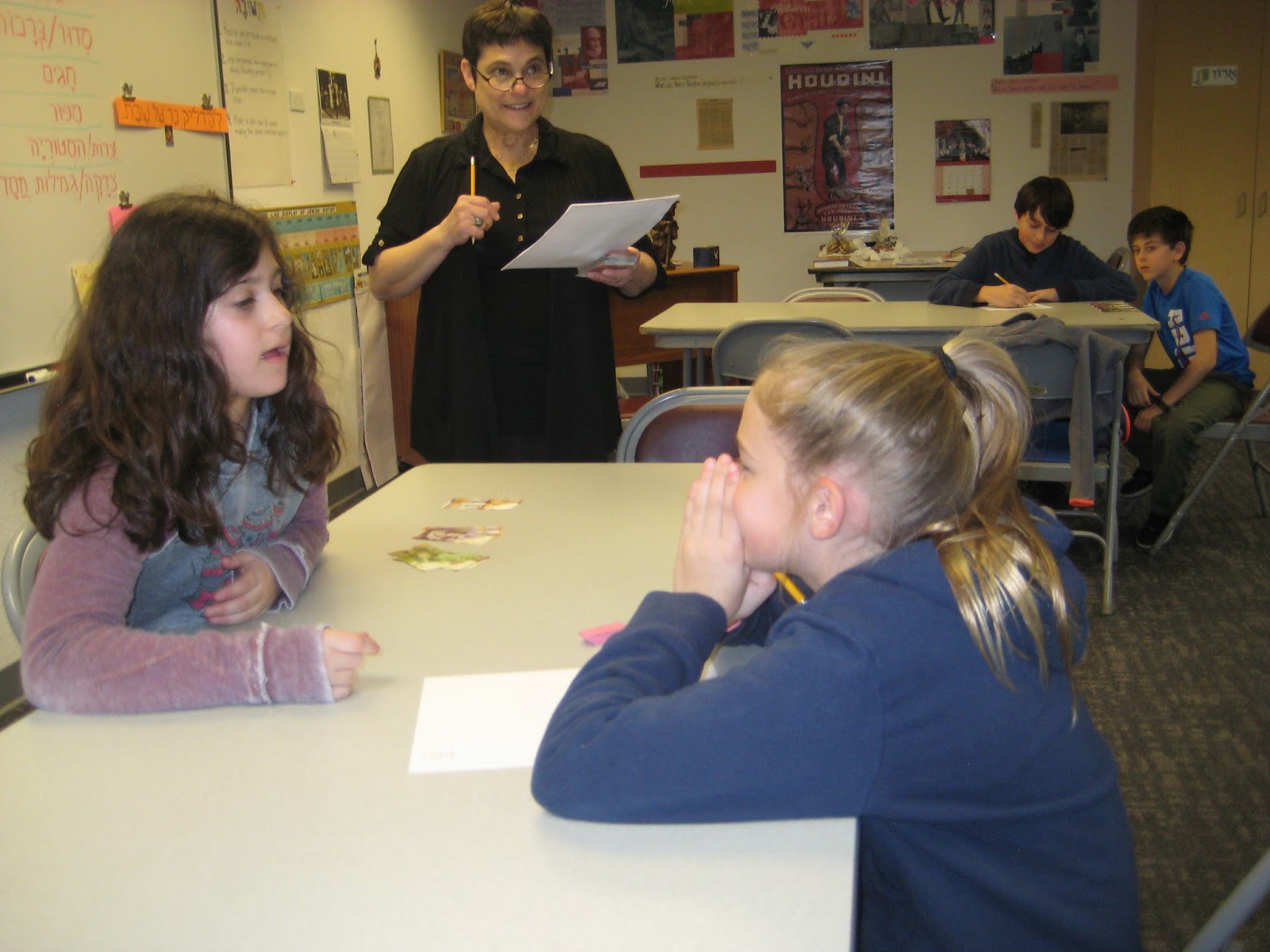
| First, we divided into two teams, and each team had to decide who would be the "battleship" and who would serve as destroyers and neutral ships. The tricky part was to speak softly enough as they were deciding so that the other team wouldn't hear them. |
 |
| Then it was time for the two teams to face each other... |
 |
| ...and, one at a time, name students in the opposite team, hoping the student they named was the "battleship" which would immediately win them the game. |
 |
| It actually took several tries before the "battleship" on one of the teams was finally discovered, at which point, the workshop came to an end and it was time for all the families to go into the Sanctuary to join the 3rd and 4th graders for tefillah. This was the first chance the fifth graders had to use their new siddurim during tefillah. |
If you were unable to join us for the workshop, your student will be given his/her new Siddur as soon as s/he is back in class, and will also be given a blank cover to bring home to decorate, along with instructions and ideas for decorating.
The final B'nai Mitzvah Prep workshop for the year will take place on Sunday, April 30th. Sixth graders and their families will meet in the Social Hall for the workshop during first session, where they will learn more about the Torah portions they've been assigned, as well as further details relating to celebrating the event at Isaiah. Fifth graders and their families will be invited that same day to join teachers for a tour of an exhibit at the Contemporary Jewish Museum, with an art activity relating to the exhibit to follow. More details will follow as we get closer to the date. I hope you can all join us for these important and, I'm sure, enjoyable events.
And remember that this coming Sunday is the holiday of Purim (beginning the evening before!), at which time we'll be enjoying games in our classroom, followed by a Purim shpiel (play) and parade and, of course, our annual LAFTY Purim Carnival. Again, I'm hoping to see you all then!