Thursday, February 9, 2017

Date Chews and Poppy Seed Cookies

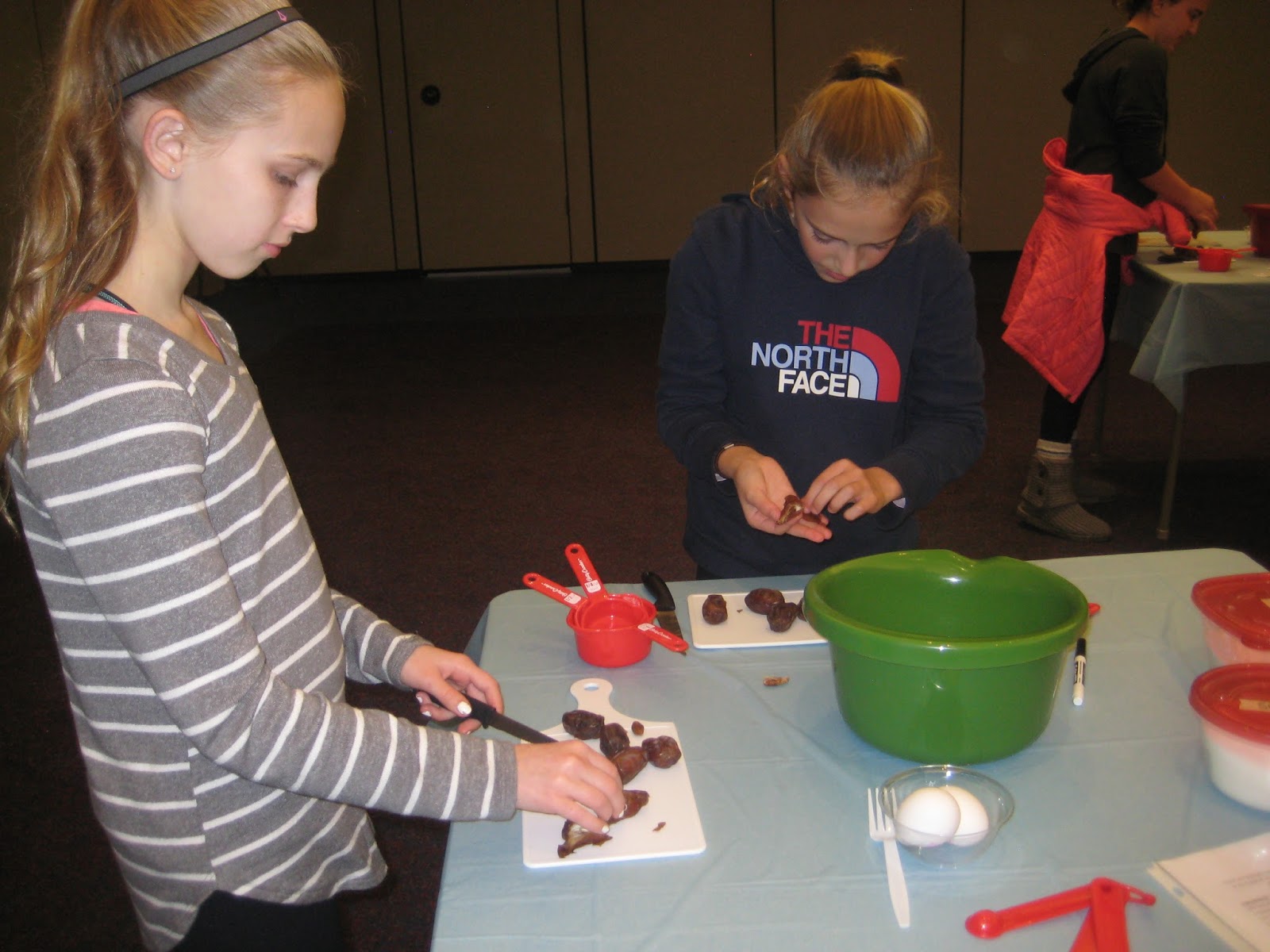
On Tuesday and Wednesday, we went from one cooking project to another with tefillah and hafsaka (recess) the only breaks between the two. We began the day up in the Oneg Room at our monthly cooking session. This month, we made date chews in honor of Tu Beesh'vat (the holiday of the trees,  which is celebrated this coming Friday night into Shabbat).

As usual, the Edot students worked together with students from Shira and Y'tzira, schmoozing about life and every subject under the sun while preparing the recipe. The results were, as usual, quite delicious!

Karen demonstrating the best way to take the pit out of the date before slicing it into small pieces.
This was, to say the least, very sticky business.
Ten large medjool dates proved to be just the right number to yield a cup of chopped dates
Once the dates were chopped, it was time to beat two eggs. Breaking the eggs without getting shell pieces mixed into the egg yolk and white proved to be a challenge.
Once the dates were chopped, they had to be coated in the flour and sugar mixture.
While some students used the spoon to coat the dates, others went all in with both hands.
Checking to be sure every single date is coated.
Once the mixture was prepared, it was time to pour it into the baking pan.
Making sure every last bit of mixture gets into the pan

We went to tefillah directly from the Oneg Room - fifth graders to the Beit Knesset and sixth graders to the Sanctuary. Since it's been too wet and cold to have outdoor hafsaka, we went to our classroom where some students opted to use the recess time to answer stumper questions to earn stickers, while others schmoozed. Then it was time to prepare poppy seed cookies, part of our unit of study about Ashkenazi Jews.

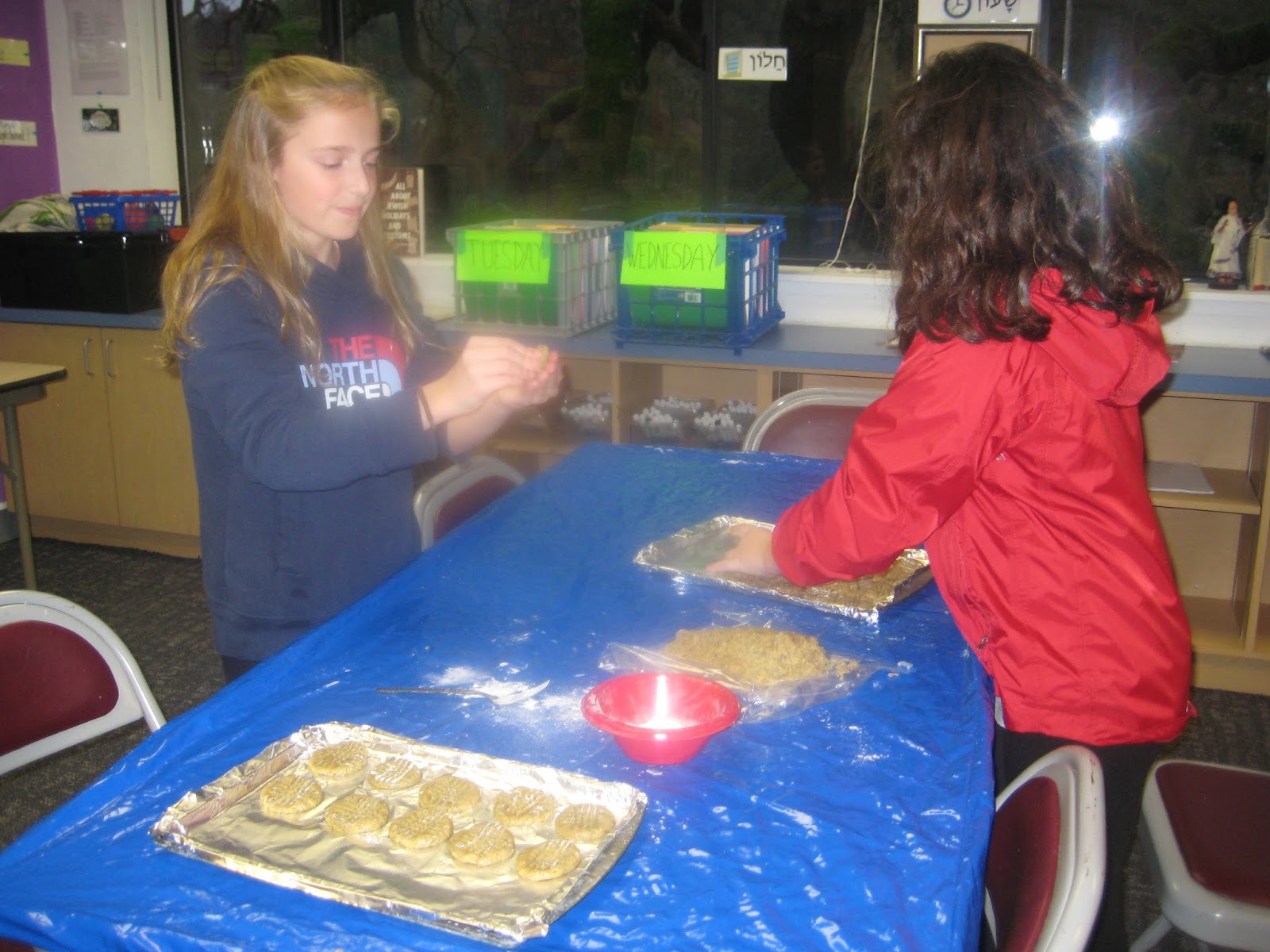
Since we didn't have enough class time to make the dough from scratch, I prepared the dough at home and the students rolled it into small balls...
...then took a fork dipped in flour and pressed the ball down, forming a crisscross pattern on the cookie as they did so.
We made gluten-free and sugar-free cookies as well.
The dough was very oily, and very sticky.
Very, very sticky!
Within 20 minutes, the cookies were all formed and lined up on the baking sheets.
All ready to pop in the oven


Once we had cleaned up and the cookie trays were in the ovens, there was still time to work on completing the Shabbat Seder Booklets we've been making for the past few weeks. Some of the students completed them and brought them home, while others will be continuing to decorate them as I read the story at the beginning of our sessions.


This coming Sunday we'll be decorating wimpels, one of the earliest forms of Ashkenazi folk art, initially from Germany and southern Italy. Stay tuned!

Monday, February 6, 2017

Yidl Mitn Fidl *

We had the wonderful opportunity yesterday both sessions to join the other two 5th/6th grade tracks in the Beit Knesset to learn about klezmer music and the Yiddish culture which produced it. David Rosenfeld, a local klezmer musician, came to JQuest as a representative of the KlezCalifornia "Tam" program. The mission of the program is to introduce children in the Bay Area to the Yiddish culture of Ashkenazi Jews. This is precisely what the Edot students have been studying for the past couple of weeks, so the timing couldn't have been better.
Here's Dave introducing himself and the subject of klezmer music. Did you know that the Yiddish word klezmer derives from two Hebrew words - "kley" (vessels of) and "zemer" (song)? We are vessels of song ourselves, producing vocals as well as other sounds that can accompany music like clapping hands and stomping our feet. And we produce vessels of song we refer to as musical instruments. All 3 came into play during the presentation.
Dave plays the mandolin and the fiddle (a violin is called a fiddle when it's used to perform folk music). He used the instruments to share how klezmer's music sound is produced. First, he played a song for us on his fiddle, so we could get a general idea of what klezmer music sounds like:


Then, he proceeded to break down the sounds to show how the klezmer sound is produced. First, he played the major scale that we are all familiar with in western music (the do, re, mi scale). Then he introduced the Freigish scale (Phrygian scale in English, and Ahava Rabah in Hebrew):


 Once we understood how the klezmer sound is produced, Dave introduced us to a rhythm or beat frequently used in klezmer music - the hora:


It's not enough to learn about the hora rhythm in words - Dave got everyone involved by teaching us to clap our hands and stomp our feet to the hora beat. Trust me, you really have to concentrate to get the hands and feet coordinated!


The hour flew by, and just as it was time to leave for tefillah (or to go home for second session students),  Dave took out his mandolin (which was made in 1937!), shared its structure, and then showed us how it's played:


He finished his presentation by playing the Yiddish song, "Bei Mir Bist Du Shayn" ("You're Beautiful to Me"), which became a hit in the United States in the 1940's, sung by the Andrews Sisters. Sadly, my camera was almost out of battery, and I knew I had to save some for Creative Tefillah. (Yes, I promise to enter the 21st century and get an IPhone and join Facebook - someday!)

A big thank you goes to Dave and to the Tam Program for sharing this rich Yiddish culture with our students. Now we can all truly appreciate our own Isaiah "Kleztones" when they play for us.

 As I mentioned, yesterday we held a Creative Tefillah between the sessions, and one of the sixth graders leading it was our own Joey. The theme the students chose to tie together the prayers we chanted was the Super Bowl, since it was played yesterday afternoon. (Congratulations to the Patriots - and a very big congratulations to the Patriots' receiver, Julian Edelman who performed amazingly in the game! Just before tefillah ended, Rabbi Miller shared a video made by Julian when he visited Israel in 2015.)

Here's Joey introducing the "Mi Chamocha" song:


And here he is again, introducing the Silent Prayer section of the Amidah:


(and my camera's battery died just as he finished!)

This coming Tuesday and Wednesday we'll be preparing two recipes. First, as part of our scheduled cooking session with Karen (on Tuesdays) and Stephanie (on Wednesdays), we'll be preparing Date Chews in honor of the Tu Beesh'vat holiday which is this coming Friday evening and Saturday. Then, after tefillah and hafsaka (recess), the Edot students will prepare poppy seed cookies in our classroom, as part of our Ashkenazeem unit of study. Once they're baked (after class is over), I'll prepare special bags filled with enough cookies for the entire family for the students to bring home the following Sunday (when we'll be decorating wimpels!) Stay tuned!

*In case you aren't familiar with the title of this post, (Yidl Mitn Fidl), it's from a movie made in the 1930's starring the Yiddish actress Molly Picon.

Thursday, February 2, 2017

Shtetl Culture

During the past two weekday sessions, I reviewed what we had learned to date about the earliest history of Christianity and the Ashkenazeem (described in my last post), including how most Jews migrated to eastern Europe following the Black Death in the mid-14th century. I then used the "Heritage: Civilization and the Jews" program (an amazing program with so much interactive information on it!) to introduce the students to the origins and structure of the Yiddish language (a multimedia part of the program, which unfortunately I am unable to copy onto the post). Part of the multimedia program gave us a chance to listen to Yiddish words being used in the context of sentences on the program, and to learn to pronounce the words and sentences. We learned that Yiddish is a fusion language made up of words borrowed from Hebrew, Romance languages (old French and old Italian from the 9th century), German grammar and vocabulary from the 9th century, and Slavic languages (added to the language after the migration to eastern Europe).

We then viewed three video segments from the "Heritage" program. The first described how the Pale of Jewish Settlement (minutes 18:02-25:47) was established in the early part of the 18th century, when Tzarina Catherine the Great conquered a huge swath of Polish territory and, for the first time in Russian history, had to deal with Jews - over 2 million of them. To protect her Russian merchants from having to compete with Jewish merchants, she ordered all Jews to live within the Pale. The segment goes on to describe attempts by Nicholas I to assimilate Jews by drafting them as young boys into the army and forcing them to convert to Christianity, and then describes the shtetl culture that arose within the  Pale (and again I used a multimedia part of the Heritage program to share details about the dress, wooden synagogues, klezmer music, food, art and storytelling aspects of the culture).

The second video segment described the origin and growth of the Hassidic Jews (minutes 42:30-45:50) throughout eastern Europe. And we ended the lesson, after I shared how this rich Yiddish culture was brought to the United States by the almost 3 million Jews who emigrated from Russia between 1880-1924, fleeing pogroms and searching for religious freedom and economic security, by viewing the third "Heritage" segment about the Yiddish Theater (minutes 36:05-38:00) that arose on Second Avenue in the Lower East Side of New York.

This coming Sunday, I'll be starting to read a new novel to the students (we just completed reading "Out of Many Waters" on Tuesday and Wednesday), called "The Circlemaker" by Maxine Schur. Its subject is precisely what we just learned about - the efforts of Czar Nicholas I to assimilate Jews into Russian Christian society by drafting all Jewish boys aged 12-25, for a 25-year term of service in his army. The novel covers not only the history of the era, but shares much of the shtetl culture, including the Yiddish language. I'll be reading the story out loud to the students until the end of the school year.

I hope you can join us at our Klezmer concert this coming Sunday. All our 5th/6th grade tracks will be gathering in the Beit Knesset to hear a local klezmer musician, David Rosenfeld,  perform the music on his "klez-violin" and mandolin. Parents are invited to join us. He'll be performing from 9:25-10:25 during the first session, and from 11:05-12:05 during second session.

Monday, January 30, 2017

Ashkenazeem

I introduced the students yesterday to the earliest history of the group of Jews most of us at Isaiah are descended from - the Ashkenazeem. To do so, we had to go back some 2,000 years, to the time when Judea was occupied by the Romans.

Since our last history lesson was about the Maccabean Revolt against the Syrian-Greeks about 2,200 years ago, I began the lesson by "storytelling" (in as exciting a manner as possible) what happened in Judea for the 100 or so years between the victory of the Maccabees and the occupation of Judea by the Romans. I then shared that once the Romans had been invited by Jewish emissaries from Judea to help them depose the corrupt Hasmonean king Hyrkanus, which they successfully accomplished, they occupied Jerusalem and the rest of Judea. Thus began the Roman occupation of our homeland, eventually leading to the destruction of the Second Temple in the year 70 C.E. and, sixty-five years later, with the unsuccessful Bar Kochba Revolt and the total ban, on pain of death, of all Jews from Jerusalem and all of Palestina (which was the Roman name for Judea).

I shared with the students that there were four major groups of Jews that evolved out of our efforts to learn to live under Roman occupation: the Pharisees (the Rabbis) who looked to interpret the Torah for answers; the Sadduccees (the Priestly Class) who performed the sacrificial rituals in the Holy Temple while it still stood, believing that the best way to deal with the Romans was to work with them; the Sicarii (the Terrorists) whose solution was to murder anyone they suspected of working with the Romans as well as the Romans themselves; and the Nazarenes, who eventually were called Christians in the Greek-speaking world outside of Judea. Their solution was to "render unto Caesar what is Caesar's and unto God what is God's" (i.e. follow both Roman law and God's commandments which they did not view as mutually exclusive).

It was the Nazarenes we focused on yesterday, as I shared videos from the "Heritage: Civilization and the Jews" dvd-rom program about the birth of Christianity (minutes 8:35-12:56), the growing tensions between traditional Jews and the Nazarenes during the first 100 years of the religion (minutes 16:42-19:02), and then jumping to the Dark Ages in Europe (minutes 17:20-24:00) to show how this gap had grown and why the Jews were persecuted. Finally, we learned that most Jews emigrated to eastern Europe following the horrific Black Death (Bubonic Plague) (minutes 42:20-48:35)  which decimated western Europe's population between the years 1347-1349 (one-third of its population died from the Plague!). It was blamed on Jews poisoning the wells, and the populace of all the western European nation-states were so set against the Jews, that no king or Church leader dared to invite them to live on their lands for many years after.

Back in the 1200's, Polish princes in eastern Europe had invited Jews to settle on their lands, to help them claim title to those lands. They promised Jews that they would not persecute them (indeed, any Christian who tried to do so would be punished), and that they could own land and enter any trade they wished. Their promises were at first suspect, but following the Black Death (which never spread to eastern Europe), the Polish princes again extended their offers, and this time, the largest wave of Jewish migrants in history moved east.

It was here that we ended our history lesson for the day so that we could join the other 5th and 6th graders for a music session with Revital and Michaela. During the coming weekday sessions, we'll be continuing our history lesson, which will focus on the rich Yiddish culture that evolved in eastern Europe.

During the past weekday sessions, our weekday music teacher, Eric, taught us a Tu Beesh'vat (holiday of the trees) song about the "Tall, Tall Trees." Yesterday, Revital and Michaela taught us an Israeli dance for a song about the earth and sky (appropriately titled, "Adama v'Shama'eem" - "Earth and Sky"). Below is a bit of the dance captured by my T.A. Max during the first session.


During tefillah, we had a representative talk to us about Camp Tawonga, near Yosemite, and then enjoyed a "Creative Tefillah" led by several Y'tzira 6th grade students. The theme they came up with was "Broadway plays." This coming Sunday, several of our Wednesday session Edot students will be leading another "Creative Tefillah." I can hardly wait to learn what theme they decide upon!

Friday, January 27, 2017

Shabbat Seder Booklets

We used our scheduled Edot time after hafsaka (recess) on Tuesday and Wednesday to continue working on the Shabbat Seder booklets which we began at the start of the semester. Each booklet, when completed, will include all the blessings used for the rituals of welcoming Shabbat into our homes on Friday evenings (lighting the candles, blessing the children, blessing the wine, washing the hands, and blessing the challah), as well as a new blessing we wrote for our parents. The booklet is the culminating activity for our Shabbat unit of study, and reflects much of what we have learned in this unit - the language of Shabbat (the Hebrew roots for words in the blessing formulas and other Shabbat related ritual words), and the order of the rituals traditionally performed to welcome Shabbat in the form of a table of contents page for the booklet.

This week, we focused on the blessing said for the sons and daughters, and we added a new tradition - a blessing to be said for our parents.

The blessing for the daughters asks God to "make you like Sarah, Rebecca, Rachel and Leah," the four matriarchs of the Jewish nation.
And the blessing for the sons asks God to "make you like Ephraim and Menashe," the two sons of Joseph, born in Egypt. According to a midrash (a Rabbinic teaching), this blessing attests to their unique strength. They were raised in Egypt as Egyptian noblemen, yet refused to give up their Jewish identities. They have become symbols of the loyalty of children to their parents and their faith.
As with all the other blessing pages for the booklet, we learned the words, recited the blessings together, then set about decorating the page to fulfill the Rabbinic concept of "heedoor meetzvah" (glorifying the commandment).
Students colored in the Hebrew letters of the blessing...
...and created symbolic drawings to represent the ritual (in this case, blessing the children).
This turned out, for the most part, to be a very calming activity, yet also a social one. Coloring in doesn't require that much attention, and as they colored, the students could socialize with each other.
As I mentioned earlier, we wrote blessings to recite over our parents.
Using the traditional wording for the short blessing formula, students filled in a worksheet to help them create the blessing.
They were asked to think of 3 positive adjectives describing their parents...
...and then think of two things to thank their parents for - first, something their parents do for them which is all too easy to take for granted (e.g. driving them to sports practices or games, helping them with homework), and second, something special their parents have done for them or given to them (e.g. taken them on a special trip, given them a very special gift). I'll be typing these up and they will be included in the booklet.
Finally, each student chose two pieces of colored construction paper which will serve as the front and back covers of the booklet.
First, they had to copy the Hebrew words "Seder Shabbat" in Hebrew letters on the top of the front cover...

...then put their full names on the bottom.
It was up to each student how to decorate the covers, with the suggestion that they use Jewish and/or Shabbat-specific symbolic drawings.
During the final fifteen minutes of each session, we joined the other 5th and 6th grade tracks for a music session with Eric Shoen, our weekday music teacher. Since Tu Beesh'vat, the holiday of the trees, is coming up on February 11th, he taught us a song about the "Tall, Tall Trees."


On Sunday, we'll be starting our new unit of study about the Ashkenazee Jews, with a focus on the Jews of eastern Europe. Stay tuned!


Monday, January 23, 2017

Shabbat Posters - Heedoor Meetzvah

We used most of our time each session yesterday to create posters depicting eight Shabbat Seder (Friday night welcoming Shabbat ceremony) rituals. Up to this point, we've learned about the rituals, the blessings for several of the rituals and the Hebrew language roots for key words in the blessing formulas and the words "shabbat" and "shalom."

I have explained several times to the students the Rabbinic concept of "Heedoor Meetzvah," which literally translates to "glorification of the commandment." The concept derives from a line in the Book of Exodus which says, "I will glorify my God." Talmudic era Rabbis asked themselves, "How can we glorify a God Who is omnipotent and omniscient and from Whom all glory emanates?" Their answer was that we could glorify God's commandments. How can we glorify God's commandments? By creating beautiful objects related to the commandments - objects used in our rituals. This encompasses creating beautiful dressings for the Torah scroll to designing beautiful keedoosh cups and candlesticks, challah covers, tablecloths for holiday tables, etc.

So today, the Edot students put their artistic skills to use to show the beauty of our Shabbat rituals. Four posters were created during each session, and the results were truly beautiful:

First comes the planning stage - here, Max and Joey are working out their design for depicting the "Ha'Motzee" blessing over the Shabbat challah.
Emma and Ashley and Jack (out of the photo frame) are figuring out which materials to use for their "Preparing for Shabbat" poster, while Abby and Maddy are deciding in the background which materials to use for their poster depicting the "Shalom Aleichem" song we traditionally sing every Friday evening, to welcome the "angels from on high."
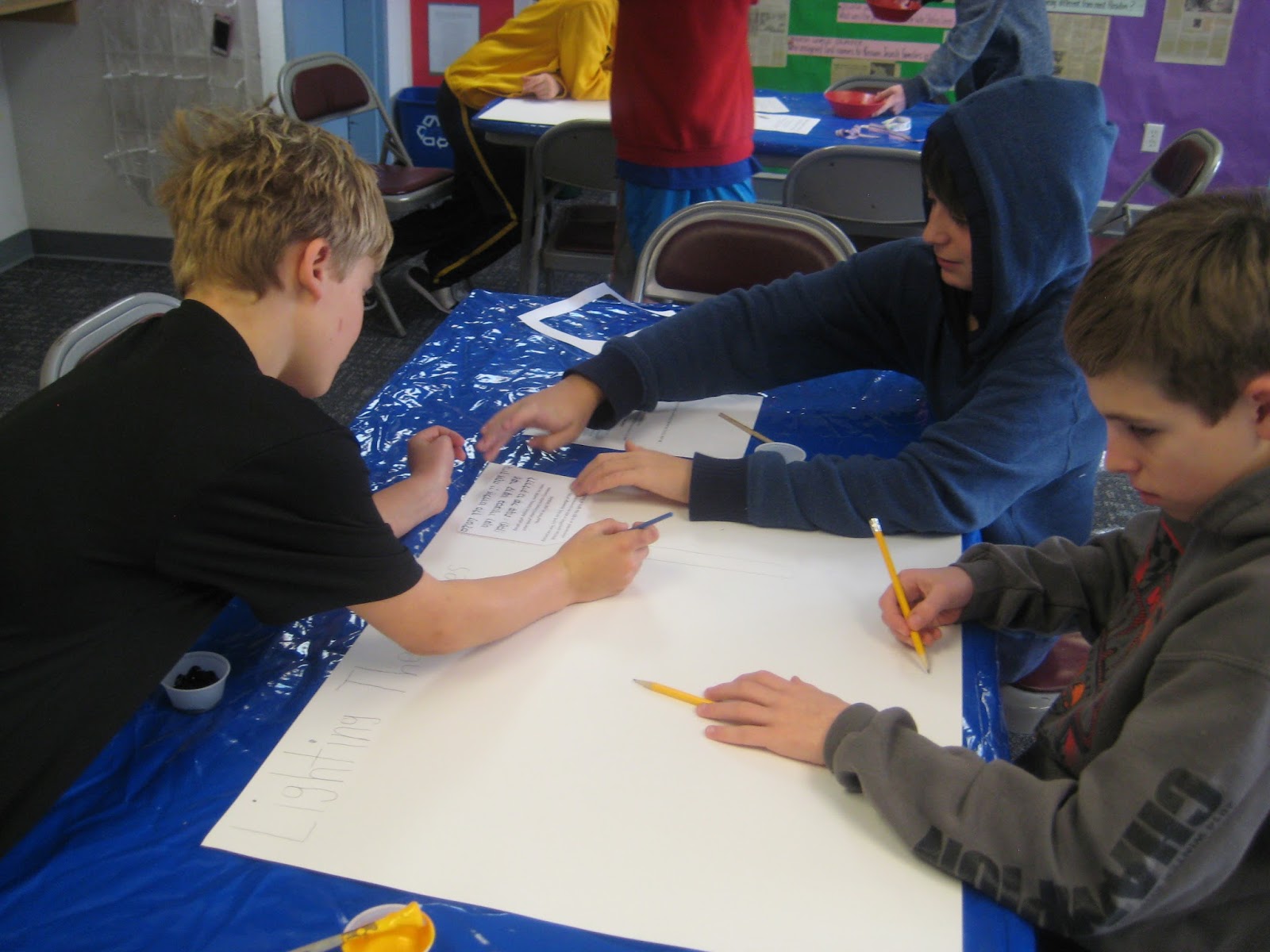
Once the students decided on a design and on the materials to use to depict their assigned ritual, they divided up the tasks and worked very well together. Here, Callen, Zach and Jeremy are working on "Lighting the Shabbat Candles."
After outlining their design in pencil, the three boys took turns adding color and detail to it.
For those rituals involving blessings, I gave a pre-printed sheet with the blessing in Hebrew, English transliteration and translation for them to glue onto the poster. Joey and Max decided they wanted to copy the Hebrew of the "Ha'Motzee" blessing by hand, with remarkable results.
Jack and Emma are carefully painting in their outlines of drawings relating to preparing for Shabbat (setting the table, putting money in a tz'daka box, dusting the furniture as part of housecleaning).
Joey is painting a "magen daveed" (Star of David) on a challah cover, which will almost completely cover the challah he and Max created out of puff balls on the poster.
Here, Rona and Emily are creating a collage which will depict the "Keedoosh" (blessing over the wine) ritual.
Gabby is busy working on a poster depicting "Blessing the Children."
And Michael is totally focused on painting images of what was served for the traditional Shabbat Meal.
Below are a couple of the completed posters. I'll be creating a Shabbat bulletin board in the hallway outside our classroom once all the posters have been completed.


We finished each session with a visit from Revital and Michaela to our Edot classroom. Revital, with Michaela's help, taught us two Yiddish songs - "L'Cho Doidee" (a Yiddish version of the Sephardee -Spanish Jewish- poem "L'Cha Dodee") and "Shabes, Shabes, Shabes," which are a wonderful introduction to our new unit of study about Ashkenazee Jews which I'll begin next Sunday. These are two of the songs which they traditionally sang at the Shabbat table, following the meal.


Friday, January 13, 2017

More Stumpers

In just a couple of weeks, I'll be introducing the second unit of study in our Edot curriculum this year - the Ashkenazeem (Jews of Europe). We'll learn what we know about their earliest history, migration to eastern Europe in mid-15th century, and the Yiddish language and culture they developed over a thousand-year period.

In preparation for this unit of study, I've put up stumpers relating to the Ashkenazeem on the "Jewish World" bulletin board in our classroom, for those students who are interested in earning stickers toward the Toys 'R Us gift certificate. Each stumper's answer is in the newspaper article hung directly below the sentence strip. One of my main goals with this program is to show the students that it's not just in our classroom that we can learn about our Jewish world - the articles are taken from The New York Times, S.F. Chronicle, Boston Globe, "J" (our Bay Area weekly Jewish newspaper), and other public sources. 

Here's an overview of the bulletin board
 Below are photos of the individual stumpers:


In case it's hard to read the stumpers from the photos, here they are:

How is Rabbi Shlomo Koenig different from most Hasidim?
Who assigned last names to Russian Jewish families in the 1700's?
What was the performance of the late Shifra Lerer always touched by?
What Yiddish name for Amsterdam do the Dutch still use today?
Who were the Jewish Gauchos? (Where did they live, where did they come from, what did they do?)
Why didn't Rashi become Rabbi for the City of Troyes?

Which language may help linguists (people who study languages) discover the origins of Ashkenazi Jews?
Why does Dr. Blaser believe many Jews were spared from the Black Death?

Parents - if you're ever curious about the answers to stumpers in the classroom, there is always an open invitation for you to come to the classroom (Room 201) to find the answers in the articles yourself. Or, of course, just get in touch with me, and I'd be glad to provide the answer!