It was such a nice surprise to see so many of my Edot students coming into the classroom yesterday morning, having made their way to school in the pounding rainstorm we experienced yesterday, our first Sunday session back from winter break.
As usual, we began the session by showing our appreciation for the snacks set out for the students to enjoy as I continued reading from "Out of Many Waters," the novel I began reading out loud back in September. How do we show our appreciation? By chanting the "ha'motzi" blessing. We learned earlier in the year, that the Jewish way of showing appreciation for any aspect of the universe is to say a blessing. According to Lurianic Kabbalists, every time we can appreciate the beauty and wonder of the universe, we are collecting a divine spark. This goes back to the
Lurianic Kabbalist understanding of how the universe was created and why we have become God's partners in helping to complete the process of creation through acts of "tikkun olam."
Once I had completed reading a chapter from the book, and we had cleared off the tables from the snacks, I immediately began to issue a series of Hebrew Through Movement commands for the students to follow. We reviewed the program's basic vocabulary of nouns, verbs and prepositions as well as Shabbat vocabulary I had introduced to them just before winter break. Then we began to focus on learning to recognize in writing some of the vocabulary of the Shabbat ritual blessings recited on Friday evenings, during the "Kabbalat Shabbat" (receiving Shabbat) ceremony performed in many Jewish homes around the world.
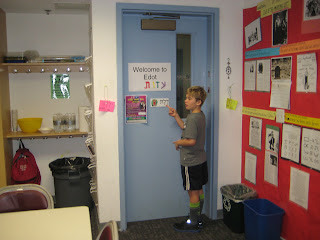 |
| Callen, l'hatzbee'a al ha'meela "delet." (Callen, point to the word, "door.") |
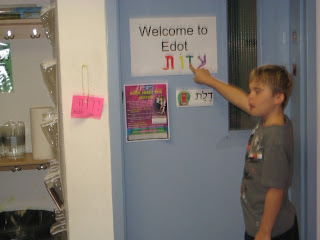 |
| Callen, leen'go'a ba'meela "eydot." (Callen, touch the word, "edot.") |
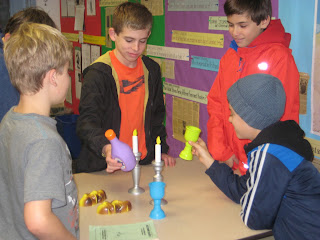 |
| Zach, l'hareem bakbook ya'een shel Shabbat; Jack, l'hareem kos keedoosh shel Shabbat. (Zach, lift up a Shabbat wine bottle; Jack, lift up a Shabbat kiddush cup.) |
 |
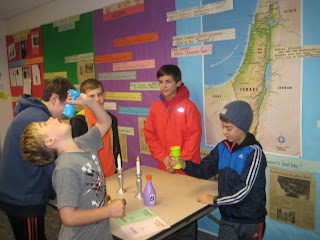
| Callen, leesh'foch ya'een me'ha'bakbook l'kos keedoosh shel Shabbat. (Callen, pour wine from the bottle to a Shabbat kiddush cup.) |
Baneem, l'varech al ha'ya'een. (Boys, bless the wine.)
 |
| Callen, leesh'tot ya'een shel Shabbat. (Callen, drink Shabbat wine.) |
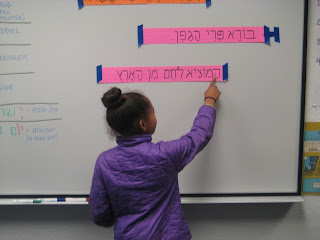 |
| Abby, leengo'a ba'bracha "Hamotzee lechem meen ha'aretz." (Abby, touch the blessing, "Ha'motzee lechem meen ha'aretz.") |
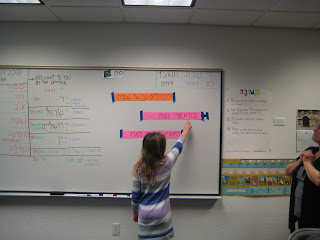 |
| Maddie, l'hatzbee'a al ha'bracha "Borei p'ree ha'gafen." (Maddie, point to the blessing, "Borei p'ree ha'gafen.") |
 |
| Maddie, leen'go'a ba'meela "Shabbat" mee'tachat l'tochneet ha'yom. (Maddie, touch the word "Shabbat" under the schedule of the day.) |
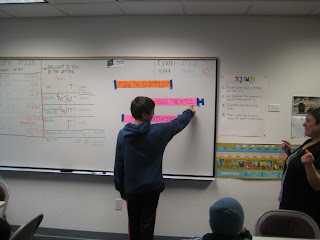 |
| Jeremy, leen'go'a ba'meela "borei." (Jeremy, touch the word, "borei.") |
 |
| Callen, l'hatzbee'a al ha'bracha, "l'hadleek ner shel Shabbat." (Callen, point to the blessing, "l'hadleek ner shel Shabbat.") |
 |
| Callen, la'seem yad al ha'meela "borei." (Callen, put a hand on the word, "borei.") |
Once our Hebrew Through Movement session was over, I segued over to our "Shabbat" unit of study, by reviewing the two most commonly used blessing formulas which I had introduced to the students before winter break - the short form and command form of blessings. The short form consists of 6 words - "Barooch Ata Adonai, Eloheynoo Melech ha'olam...." ("Blessed are You Adonai, our God, Ruler of the universe...."). The command form adds four more words to the blessing - "...asher keed'shanoo b'meetzvotav v'tzeevanoo...." (...Who has made us holy with His commandments and has commanded us....."). This command form is used for any ritual which we are commanded to do in the Torah. The short form of blessing is used for whatever is not specifically commanded in the Torah - most of the blessings we say over food, for example. Once we had reviewed this information, I introduced a new shoresh (root) for a word found within both blessing formulas - "melech" (king or ruler). We learned that any word built from the "m-l-ch" shoresh must have something to do with royalty or ruling. I shared the words "malka" (queen), "malchoot" (kingdom), and "leem'loch" (to rule). Students then went to their folders to take out the blessing sheets they have been working on for our Shabbat Seder booklet project, begun before winter break. We had already discussed the "keedoosh" (blessing over the wine) vocabulary and had learned to chant it together. Most students had already completed decorating their "keedoosh" blessing sheets. I introduced the "l'hadleek ner shel Shabbat" (lighting the Shabbat candles) blessing (the vocabulary to which I had already introduced the students to during our HTM sessions). I handed out the worksheets for this blessing to the students, then asked them to tell me if this was a short or command form of blessing. Most realized just from the number of words in the blessing, that it was a command form, since we are commanded to observe Shabbat in the Torah. We then practiced chanting the blessing with the melody we use in Temple Isaiah (and many other Reform synagogues). Then it was time to decorate the blessing sheet. (Just before winter break, I had introduced to the students the Jewish concept of "heedoor meetzvah" - "glorifying the commandment" which Talmudic Rabbis introduced. This encouraged Jews to "make beautiful the commandment - i.e. decorate ritual objects and related materials in order to glorify God and God's commandments.) Once most of the students finished decorating this blessing, I handed out the sheet for the "Ha'motzee" blessing (blessing over the challah bread), and before I could even ask, a couple of students immediately recognized this as a short form of blessing. The final blessing I introduced yesterday was the blessing we say before washing our hands before blessing the bread - "neteelat ya'da'eem." This is a command form of blessing, since the Kohaneem (priests) of the Holy Temple in Jerusalem were commanded in the Book of Leviticus to wash their hands before each sacrifice. I explained that according to Rabbinic law, hands must be washed in "ma'yeem cha'yeem" ("living waters"), and we discussed what this could mean. Some students offered that it must be water in which living things like fish can survive. Another student jumped on that idea, and said that to survive, living things have to have oxygen, so it must be water that has oxygen in it. I asked what kind of water that would be, and another student suggested "water that moves, to make bubbles of oxygen." This is precisely what the Rabbis had in mind (though I'm not sure they knew about the oxygen part). We then practiced reciting the blessing, and students began to decorate the page just before our "Shabbat" session ended and Revital, our music director, came into the classroom to teach us a song and a hora dance that goes with the song.
Once Shira and Y'tzira students joined us, Revital sang "U'sh'avtem Mayeem" ("And you shall draw forth water") for the students, and then asked which word she repeated most often in the song. Immediately many of them yelled out "mayeem" (water). (Quite an appropriate song to learn with the rain pounding against the windows as we learned it.) Not only did we learn the song, but also learned the basic steps to the hora circle dance, and specific steps for the "Mayeem" song.
Finally, it was time for us all to go up to the Sanctuary for tefillah with all the K-6th graders. It was a special tefillah, in that we were introduced to Camp Newman, the Reform Movement's summer (and winter) camp in Santa Rosa, through a video which we watched. The camp representative (a Rabbi whose name I unfortunately forgot) was able to answer questions the children had about the camp.
This coming Tuesday and Wednesday, we'll be having our fifth cooking session with Karen (Tuesday) and Stephanie (Wednesday), during which we'll be preparing rugelach. Tuesday and Wednesday will also be the first day that our sixth graders join the 7th graders in the Sanctuary for tefillah with Cantor Korn.
See you then!