Thursday, October 27, 2016

Writing Letters Home

During the past two weekday sessions, each of our Edot students "became" a Jewish pioneer who is either buried in the Sonora Pioneer Jewish Cemetery or who ran a business in nearby Columbia. I assembled "archives" for each pioneer several years ago, with the help of Dr. Ava Kahn who was once the chief archivist at the Magnes Museum's Western Jewish History Center (which archives are now part of UC's Bancroft Library), and who visited my classroom several years ago to speak to the students about how archivists assemble materials and use them for research.

Using a summary sheet of what we know at this point about the life of the pioneer, as well as other documents written by or about the individual, and some photographs if any were taken, the students took time to get to "know" their assigned pioneers. Once this was accomplished, I asked them to write a "letter home" to one or more family members they had to leave behind in Europe. This assignment (which will be completed next week) will allow each student to review what we've learned in class about the reasons young Jewish men (and later women) left their homes to embark on a dangerous journey to California, how they coped during the journey, how they tried to maintain their Jewish identity and faith during the trip and once they settled in California, and what their lives in Sonora or Columbia were like - how they earned their living and participated in the Jewish communal life they established in the mining towns.

This letter, I explained to the students, can be classified as "historical fiction." We have a lot of information about a handful of the pioneers, but for many others we know precious little - in some cases, only what was inscribed on their gravestones (or at least, what is still legible on the stones). In order to write the letters, the students are being asked to "fill in" missing information using facts we learned along with their imaginations. These letters will be read by students going on the Gold Rush field trip on November 6th, as they stand next to the grave of the pioneer in the cemetery, or in front of the store run by the pioneer on Columbia's historic Main Street.

Michael is "becoming" Hartwig Caro, the very first Jew to be buried in Gold Rush country - he was only 17 years old when he died.
Joey is "becoming" Phillip Schwartz," who ran the "New York Fancy Dry Goods" store on Columbia's Main Street.
And Max is "becoming" Aron Jacob, a Jamestown merchant, who succumbed at the age of 34 to a cholera epidemic that swept through the town in 1862 (his wife, Mary died 4 months later at age 33 from the same cause). The children they left behind (we're not sure how many) were sent to San Francisco to be cared for by relatives - a pattern not uncommon in the Gold Country.
These letters will become part of a "documentary" bulletin board I'll be putting up in the hallway outside our classroom after our field trip, sharing what we learned about the Jews of the Gold Rush with other students and teachers, as well as visitors.

We only had a short amount of time to begin writing the letters on Tuesday and Wednesday, since the first part of each session was dedicated to the second of our 8 scheduled cooking classes with Karen (on Tuesday) and Stephanie (on Wednesday). This time, they led us in preparing a light and delicious "Seemaneem" fruit salad. Hopefully, you've received an e-mail from the school office with the recipe attached by the time you read this post. "Seemaneem" means "symbols" in Hebrew, and the fruits we sliced and diced for the salad are all grown in Israel. It's a popular recipe for the Sukkot holiday, which commemorates the harvest of the first fruits in the Land of Israel in ancient days.

We began the session each day by gathering around the demonstration table so that Karen (pictured above) and Stephanie could show everyone the safe and most effective ways to slice and dice the fruit.
Here's Stephanie sharing the recipe with us on Wednesday.
Then the students divided up to work at separate tables - no more than 4 to a table. They divided the work between themselves so no one stood idly by. Here's Gabe separating the seeds of the pomegranate.
The trick is to separate them in a bowl of water, so that the heavier seeds sink to the bottom while the lighter inside skin floats to the top and can be easily picked out of the water.
Then, it's a simple step to scoop up the seeds (as Jeremy is doing here) and let them drain in the hands...

...then put them on a paper towel to dry off and transfer them into the fruit salad bowl, as Jack is doing here.
Here, Joey is working on separating the date pit from the meat of the fruit.
Here's Callen slicing the dates.
Michael is working on slicing the apple. The first cut is the hardest, as many students quickly discovered.
Each student found his/her own method for slicing and dicing. Here's Joey demonstrating his apple slicing technique.
You have to put some muscle into that first cut, as Abby is demonstrating here.
Peeling oranges wasn't as easy as some thought it would be. Michael is working on his orange peel here, piece by piece.
Abby decided to peel her orange section by section.
The sliced orange is now ready for Abby to put into the fruit bowl.
Once the fruits were all sliced and diced and transfered to the fruit bowl, it was time to squeeze lemon into a plastic 2 oz. tasting cup.
Then one tablespoon of the juice was measured out, to be poured over the fruit.
Then it was time for one student from each table to go to Karen for the final ingredient - 1/2 cup of orange juice, which was poured over the salad as well.

Stir it all together, and voila - seemaneem fruit salad ready to eat!

Divide it up into bowls for each member of the group...
...bring it over to tables in the back of the Oneg Room that had copies of the b'racha (the blessing) we say over fruits that grow on trees...
...recite the blessing together, and eat and enjoy!
As a final note, a few students noticed pomegranate juice stains on their shirts. If it's not too late, I found this website with steps to follow to remove the stains. It's not guaranteed, but it's worth a try.

B'TEYAVON!  BON APPETIT!


Monday, October 24, 2016

Simchat Torah Celebration

Yesterday afternoon and evening, all of JQuest met for an hour of class, and then we all went up to the Social Hall to have a pizza dinner followed by a community celebration of this final holiday of the month of Tishrei.

During our classtime together, I read "A Torah is Written," to the class, which describes in great detail how a trained "sofer" (scribe) prepares the materials used for copying a "sefer Torah" (Torah scroll) - the parchment, ink and quill - and shares all the laws a sofer must follow to produce a "kosher" sefer Torah for a community. I wanted my students to be aware of the skill and time and patience it takes a sofer to copy a sefer Torah, so that they could truly appreciate our Isaiah Torah scrolls during the Simchat Torah celebration.

Once we joined everyone upstairs in the Social Hall, we found tables laden with wonderful things to eat for our dinner, brought by JQuest families
Every table set up in the Social Hall had two boxes of hot pizza waiting to be gobbled up
The tables filled up very quickly - and there were a lot of tables! Fortunately, there were more tables set up outside where families could dine 'al fresco'
Once dinner was over, it was time to move to the Sanctuary to joyously celebrate our having completed reading all five books of the Torah, and to symbolically begin reading them again.

But before we began unrolling the Torah scrolls, all the JQuest kindergarten students and other new students to JQuest were asked to come to the bima and help lead us all in chanting the "Sh'ma" prayer.


Then Rabbis Shanks, LaVine and Miller and Cantor Korn pronounced the priestly blessing in Hebrew and English over the children as they stood under a "chupah" (canopy) created by a tallit (prayer shawl) held over them.

Finally, it was time to unroll the Torah scrolls:


Rabbi Shanks pointed out the special place in the Book of Exodus (the second book of the Torah) where the pattern of the words on the parchment is designed to reflect the description the words share of the crossing of the Israelites on dry land between the walls formed by the waters of the Reed Sea as they parted:


I managed to snap photos of two of our Edot students as all this was going on -

Callen (with his brother) and...
...Zach (with some friends).
Once the Torahs were rolled back up and "dressed" again, they were taken to the Oneg Room where we continued our Simchat Torah celebration by dancing -

First the Hora (with the Torah)!:


and finally, led by our DJs Dennon and Doyle, in other forms of joyous dance!


CHAG SIMCHAT TORAH SAMEACH!

Thursday, October 20, 2016

Preparing for the Journey

Now that I have shared the first 200 years of the history of Jewish presence in the United States, we're beginning to prepare for our upcoming field trip to Sonora and Columbia in the Mother Lode country. Last Sunday, we divided into four groups and each group was assigned a particular problem that new Jewish immigrants to the American West had to confront and solve.

Once each group had listed solutions to the problem with which they were presented, we discussed the solutions and made a list on the white board. I typed up the solutions the students came up with, and the worksheet will become part of an "archive" each student will receive for a project we'll be working on next week - stay tuned!

During the last two weekday sessions, we prepared for our trip in a very different way - we prepared hardtack and 1-2-3-4 cake (so-named because many pioneers were illiterate, and could only follow simple recipes that were easy to memorize). This cake is made by mixing together 1 cup butter, 2 cups sugar, 3 cups flour and 4 eggs, then baking it in a 350 degree F oven for an hour. Jewish peddlers learned to make these from farmwives and miners whom they encountered as they peddled their wares. We made enough of both to share with everyone who will go on the field trip; those students not able to participate will get pieces of hardtack to take home next week, and we'll enjoy a taste of the cake next Tuesday and Wednesday, while I read "Out of Many Waters" at the start of each session.


Did I mention that the batter for the 1-2-3-4 cake is sticky?
I warned the students to keep one hand free of the bowl...
...because it's hard to get the batter off your hands if both are "involved."
Luckily, there were a few clean hands left in the room to help get most of the batter off the hands...
...and into the pan!
Finally, I added three more stumpers to the holiday bulletin board in honor of Sukkot:


1.) Who is the "Hatan Torah'? Who is the 'Hatan Beraysheet'?
2.) What is another name for Sukkot in the Bible?
(you can find the answers to the above 2 stumpers in the "Jewish Holidays and Customs" book on the window sill in our classroom!)
3.) Which American holiday, founded in 1621, is based on Sukkot?

MOADEEM L'SEEMCHA - ENJOY THIS WONDERFUL SUKKOT HOLIDAY! 

Monday, October 10, 2016

The Golden Land

I introduced our first unit of study to the Edot students yesterday morning - the American Jewish edah - by  sharing a video segment from the "Heritage: Civilization and the Jews" dvd-rom program, in order to help bring to life the first 200 of the 350+ year experience of Jews in the "Golden Land." You can view the video here. (I played the segment beginning at 5:07 and finished at 17:45.)

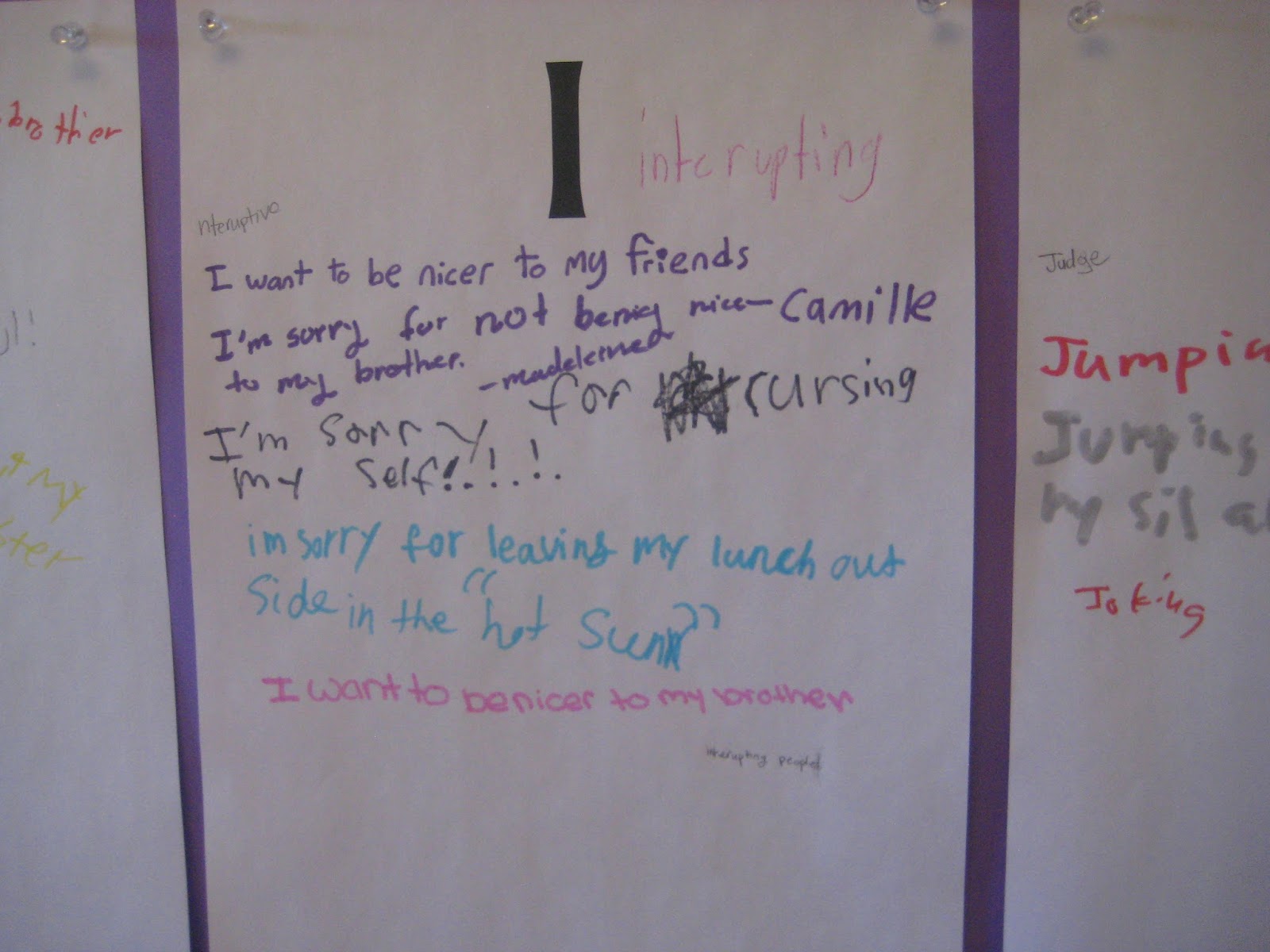
Since yesterday was the 7th day of Tishrei, we focused a good part of the session also on Yom Kippur (which begins tomorrow evening at sundown). We had discussed the concept of "t'shuva" (atonement) in class just prior to Rosh Ha'shana. Now, we focused on the "Ashamnu" prayer, the prayer we recite on Yom Kippur together as a community, asking forgiveness for our sins. The prayer is an acrostic, in which our sins are recited in the order of the Hebrew alphabet. In order to provide our 3rd through 6th grade students an opportunity to ask for forgiveness, Rabbi Greninger had 26 posters hung up on the walls of our school building's upstairs hallway - each piece had a letter of the English alphabet printed on its top margin. The students were then asked to write a "sin" - something they were sorry they did or thought during the previous year, beginning with the letter of the alphabet at the top of the page. I found it interesting that many of the Edot students found it hard to think "in the negative." Instead, they wrote positive messages to themselves on the posters of how they would improve their conduct.

This,  in my opinion, was a particularly powerful statement
We had our second session of music with Revital and Michaela and the other 5th and 6th grade students at the end of each session yesterday.
Using the powerful song sung on Yom Kippur called "Pitchu Li Sha'arei Tzedek" ("Open for me the Gates of Righteousness"), Revital taught us how musicians through the ages have used the "melismatic" form of compositions, where several notes are assigned to one syllable of a lyric in order to give a more emotional tone to a song.   
G'MAR CHATIMA TOVA - MAY WE ALL BE SEALED FOR A GOOD YEAR!